


 PLATFORM UPDATE:

Investigating the potent antibacterial, antibiofilm, antidiabetic, and antioxidant activities of biosynthesized iron oxide nanoparticles: recyclable catalyst for ammoxidation of aromatic aldehydes
 *a
Dasarath
Mal,
e
*a
Dasarath
Mal,
e
Abstract
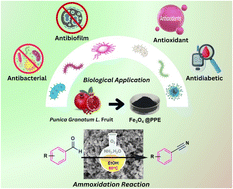
An economically efficient and operationally simple method was developed for synthesizing Fe3O4 nanoparticles using the aqueous peel extract of Punica granatum L. fruit. The biosynthesized Fe3O4@PPE nanoparticles were characterised using different analytical techniques, such as UV-visible spectroscopy, Fourier transform infrared spectroscopy (FTIR), X-ray diffraction (XRD) analysis, scanning electron microscopy (SEM), energy-dispersive X-ray analysis (EDAX), elemental mapping analysis, transmission electron microscopy (TEM), dynamic light scattering (DLS) and zeta potential analysis, which confirmed their outstanding morphology and stability. The synthesized nanoparticles were investigated as a potent source of antimicrobials towards methicillin-resistant Staphylococcus aureus (Gram-positive MRSA1 and MRSA2) and Escherichia coli (Gram-negative). Moreover, the biosynthesized Fe3O4@PPE NPs were effective in inhibiting chronic infections by decreasing the biofilm formation. The biosynthesized Fe3O4@PPE NPs demonstrated anti-diabetic properties by inhibiting amylase activity (50.89% alpha-amylase inhibition at 400 μg mL−1) and scavenging ROS (78.5% at 200 μg mL−1), highlighting their anti-oxidant activity. Moreover, the catalytic efficiency of the biosynthesized Fe3O4@PPE NPs was explored for the ammoxidation of aromatic aldehydes to aryl nitriles under an O2 atmosphere. Notably, the catalyst was recycled and used for five consecutive cycles, and its good catalytic reactivity was maintained. This study provides a green synthetic route for nitriles from easily accessible aldehydes and ammonia using a cost-effective catalyst in the presence of atmospheric O2 as an eco-friendly oxidant.
 Please wait while we load your content...


