


 PLATFORM UPDATE:

Natural versus organophilized smectites as drug adsorbents: experiment and molecular modeling

Abstract
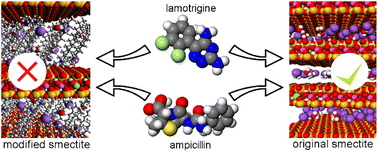
To adsorb pollutants from water, smectites are commonly modified with quaternary ammonium compounds. However, these are also environmentally hazardous. This study aims to highlight that original smectites can compete with modified ones and that modification is not necessary. Original smectites – montmorillonite (MMT), beidellite (BEI), nontronite (NON) – and the same smectites modified with tetradecyltrimethylammonium (TTA+), denoted as MMT-M, BEI-M, NON-M, were studied as adsorbents of drugs ampicillin (AMP) and lamotrigine (LAM). Adsorbents before and after adsorption were studied using Fourier-transform infrared spectroscopy, elemental analysis, X-ray powder diffraction, thermogravimetry, and molecular modeling. The adsorption efficiency of original smectites reaches or exceeds (for LAM on BEI and NON) 50 mg per 1 g of adsorbent. Adsorption is not monolayer and the order BEI > MMT > NON for both AMP and LAM was found. While AMP is preferentially adsorbed through interaction with Na+, LAM is preferentially adsorbed through interactions with other LAMs. For modified smectites, the adsorption efficiency ranges from units to lower tens of mg per 1 g of adsorbent in the order MMT-M > NON-M > BEI-M and NON-M > MMT-M > BEI-M for AMP and LAM, respectively. The adsorption can be considered monolayer, and it is not controlled only by the strength of drug–TTA+ interaction. It can be concluded that (1) the modification did not enhance the adsorption efficiency of original smectites, (2) the original smectites showed higher adsorption efficiency compared to the modified ones, and (3) the original smectites are a suitable environmentally friendly alternative to the commonly used modified smectites.
 Please wait while we load your content...


