


 PLATFORM UPDATE:

Salinity and alkalinity impacts on the interfacial activity of crude oil–water systems using individual and mixtures of a surface-active ionic liquid and conventional surfactant

Abstract
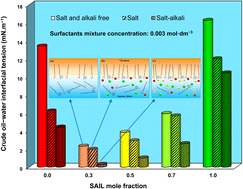
Surface-active ionic liquids (SAILs) in combination with conventional surfactants offer promising effects on the interfacial properties of crude oil–water systems. Relevantly, aqueous phase salinity and alkalinity exert inevitable impacts. This study explores the impacts of salt and salt–alkali media on the interfacial behavior of a long-chain cationic imidazolium-based SAIL, [C12mim][Cl], and the anionic conventional surfactant SDS, individually and in mixtures. Results indicate that SDS alone exhibits higher efficiency, and exposure to salty and/or alkaline media gives rise its activity through a significant reduction in interfacial tension and critical micelle concentration (CMC). Using a surfactant mixture, adaptive charge interactions between surfactants yield synergistic effects in IFT and CMC reductions with optimal performance at a SAIL mole fraction of 0.3. Salt and alkali amplify interfacial activity, resulting in IFT reductions from 26.5 to 1.6 mN m−1 with 3.0 wt% NaCl and further down to 0.2 mNˑm−1 with 3.0 wt% NaCl and 1.5 wt% NaOH. Besides, corresponding CMCs dropped substantially, from 9.8 × 10⁻³ and 9.4 × 10⁻³ mol dm−3 to 2.3 × 10⁻³ in a saline medium and 1.5 × 10⁻³ mol dm−3 in a saline–alkaline medium, respectively. Theoretical analyses, based on the Gibbs adsorption equation and the Rosen model, were employed to evaluate the adsorption characteristics of the individual surfactants and their mixtures, revealing reasonable key parameters that provide deeper insights into basic concepts.
 Please wait while we load your content...


