


 PLATFORM UPDATE:

Enzymatic, cell-based, and in silico evaluation of di-substituted aminomethyl-1,2,3-triazole–cinamamide hybrids as mushroom tyrosinase inhibitors
 *ah
*ah
Abstract
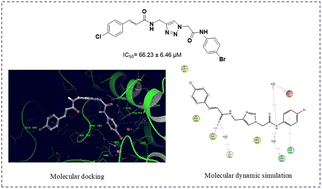
A series of novel aryl-substituted aminomethyl 1,2,3-triazole–cinamamide hybrids (9a–q) were synthesized and tested as tyrosinase inhibitors using enzymatic, in silico, and cell-based assays. A multi-step synthetic procedure, involving coupling N-(prop-2-yn-1-yl)cinnamamide intermediates with various azido-functionalized anilide derivatives and click chemistry, gives the final 1,2,3-triazole-linked hybrids in good yields. SAR studies pointed out that compound 9i (R1 = 4-Cl, R2 = 4-Br) was the best tyrosinase inhibitor and was found to be a promising antioxidant in DPPH radical scavenging (51.82% at 200 µM). Kinetic studies on the enzyme reveal that the inhibition type is competitive with a Ki value of 34.36 µM. Further molecular docking and molecular dynamics simulations supported the strong binding interaction of 9i in the tyrosinase active site via π–π stacking interactions with the His residues and hydrogen bonding with important catalytic residues. Consistent with these findings, in vitro studies showed that 9i had low cytotoxicity to B16F10 melanoma cells at concentrations ≤100 µM but was able to reduce intracellular melanin content from 92 to 62 µg mL−1. Therefore, compound 9i represents a potent tyrosinase inhibitor with antioxidant and anti-melanogenic properties, which might further assist in the development of anti-melanoma agents.
 Please wait while we load your content...


