Issue 45, 2025, Issue in Progress

Optoelectronic and thermoelectric response of lead-free halide double perovskites Rb2BiAuX6 (X = Cl, Br, I) for energy storage applications

Abstract

Double perovskite materials garner a lot of attention because of their extraordinarily high conversion efficiency in solar cells. Here, we report a detailed first-principles study on the structural, mechanical, optoelectronic, and thermal characteristics of Rb2BiAuX6 (X = Cl, Br, and I) lead-free halide double perovskites. Rb2BiAuCl6 exhibits more favorable nature than the other two materials owing to its lowest formation energy. Rb2BiAuX6 (X = Cl, Br, and I) possess mechanical stability, supported by their high elastic constants. Interestingly, these double perovskites reveal a semiconductor nature with a band gap of 1.8 eV, 1.12 eV, and 0.61 eV for Rb2BiAuCl6, Rb2BiAuBr6, and Rb2BiAuI6, respectively. The high absorption peaks in their optical spectra confirm their suitability for solar cells applications. Rb2BiAuCl6 demonstrates a higher ZT value of 0.78 at 300 K compared to the other two materials. Furthermore, thermodynamics analysis confirm their suitable behavior under varying pressure and temperature. These results suggest the potential of these double perovskites for promising applications in solar cells and thermal devices.
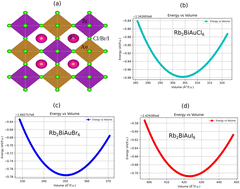
Graphical abstract: Optoelectronic and thermoelectric response of lead-free halide double perovskites Rb2BiAuX6 (X = Cl, Br, I) for energy storage applications

Transparent peer review

To support increased transparency, we offer authors the option to publish the peer review history alongside their article.

View this article’s peer review history

Article information

Article type
Paper
Submitted
24 Jun 2025
Accepted
18 Sep 2025
First published
13 Oct 2025
This article is Open Access
Creative Commons BY-NC license

RSC Adv., 2025,15, 37999-38013

Optoelectronic and thermoelectric response of lead-free halide double perovskites Rb2BiAuX6 (X = Cl, Br, I) for energy storage applications

F. Ali, M. Hussain, H. Ullah, J. Wang and M. Alomar, RSC Adv., 2025, 15, 37999 DOI: 10.1039/D5RA04508H

This article is licensed under a Creative Commons Attribution-NonCommercial 3.0 Unported Licence. You can use material from this article in other publications, without requesting further permission from the RSC, provided that the correct acknowledgement is given and it is not used for commercial purposes.

To request permission to reproduce material from this article in a commercial publication, please go to the Copyright Clearance Center request page.

If you are an author contributing to an RSC publication, you do not need to request permission provided correct acknowledgement is given.

If you are the author of this article, you do not need to request permission to reproduce figures and diagrams provided correct acknowledgement is given. If you want to reproduce the whole article in a third-party commercial publication (excluding your thesis/dissertation for which permission is not required) please go to the Copyright Clearance Center request page.

Read more about how to correctly acknowledge RSC content.

Social activity

Spotlight

Advertisements