


 PLATFORM UPDATE:


Tough dual-network Janus hydrogel patch for universal and reversible adhesion
 a
Xinling
Wang
*a
a
Xinling
Wang
*a
Abstract
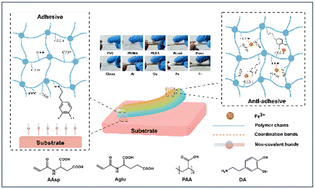
Traditional hydrogel adhesives hold tremendous potential in applications of hemostasis, wound closure, and tissue regeneration. However, significant challenges exist concerning the unsatisfactory mechanical properties and indiscriminate adhesion of the hydrogel, which possibly result in unwanted postoperative adhesion of tissues. In this work, a Janus hydrogel was fabricated from naturally-derived aspartic acid, glutamic acid, and dopamine. The hydrogel accomplishes the dual-sided property modulation through the coordination of Fe3+, maintaining high adhesion on one side while eliminating most of the adhesion on the other, efficiently averting unintended adhesion. Remarkably, this hydrogel patch not only attained robust mechanical strength (around 410 kPa) and stability via the formation of a secondary network through coordination bonds, but also exhibited excellent adhesion properties (over 550 J m−2) and repeatable adhesion (less than 20% decreasing after 5 adhesion cycles) originating from catechol surface chemistry and topological entanglement strategies. Moreover, the hydrogel boasts exceptional biocompatibility, making it advantageous for diverse biomedical scenarios.
 Please wait while we load your content...


