


 PLATFORM UPDATE:


Methodological insights into sulfur immobilization techniques on commercial carbon for lithium–sulfur batteries

Abstract
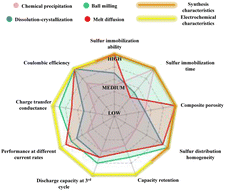
Lithium–sulfur batteries (LSBs) are considered as some of the most promising next-generation energy storage systems due to their high theoretical capacity and energy density. However, their practical application is hindered by challenges such as the shuttle effect, low conductivity of sulfur, and volume changes during cycling. A key factor to address these issues is the strategy used to incorporate sulfur into the carbon host, which significantly affects the cathode structure and electrochemical performance. In this study, we compare four distinct sulfur immobilization strategies – chemical precipitation (ChP), ball milling infiltration (BM), dissolution-crystallization (DC), and melt diffusion (MD) – using acetylene black (AB) as a conventional conductive carbon host. Each method yields AB@S composites with varying sulfur distributions, loading efficiencies, and interfacial characteristics. Comprehensive morphological and electrochemical characterization, including thermogravimetric analysis (TGA), scanning electron microscopy (SEM), and X-ray diffraction (XRD), confirms differences in sulfur content, particle morphology, and crystalline structure depending on the infiltration route. Electrochemical testing reveals that the synthesis approach is critical in determining the redox kinetics, reversibility, and cycling stability of Li–S batteries. Among the tested approaches, the AB@S cathode fabricated via the BM method delivers the most balanced performance, showing a comparatively high initial discharge capacity of 816 mAh g−1 at 0.1C, improved coulombic efficiency, and enhanced long-term cycling stability, retaining 68% of capacity, unlike DC and MD (about 60%) and ChP (55%) cells.
- This article is part of the themed collection: 13th International Conference on Nanomaterials and Advanced Energy Storage Systems special issue
 Please wait while we load your content...


