


 PLATFORM UPDATE:


Insight into the oxidase-mimicking activity enhancement of MnO2 nanozymes by Co ion-doping for colorimetric sensor assays

Abstract
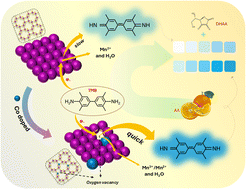
Manganese dioxide (MnO2) nanomaterials have garnered significant attention as enzyme mimics due to their excellent catalytic properties. However, when applied to catalytic oxidation in biological systems, pure MnO2 has shown limited performance. To address this limitation, we synthesized Co-doped MnO2 nanoparticles with enhanced oxidase-mimicking activity through a facile chemical method. These Co–MnO2 nanoparticles are characterized by the structural incorporation of Co ions into the MnO2 lattice, likely substituting Mn sites, which crucially induces a high density of surface oxygen vacancies (OVs), a key factor for enhanced catalysis. The presence of these OVs, confirmed by XPS, alongside the introduction of Co, leads to modulated electronic configurations and promotes the active participation of Mn3+/Mn4+ and Co2+/Co3+ redox couples. This combination is believed to facilitate synergistic catalytic reactions and accelerated electron transfer during catalytic reactions. Co–MnO2 nanoparticles demonstrated notable kinetic parameters toward the oxidation of 3,3′,5,5′-tetramethylbenzidine (TMB), exhibiting a low Michaelis–Menten constant (Km = 1.17 mM) and an elevated maximum velocity (Vmax = 4.69 × 10⁻⁶ M s−1). UV-Vis spectroscopy and colorimetric analysis revealed a notably intensified chromogenic response at 650 nm for Co–MnO2 systems. Leveraging these properties, a sensitive and reliable colorimetric platform was developed for ascorbic acid (AA) detection, achieving a broad linear range (2–100 μM) and a low detection limit (1.23 μM). The practical application of this colorimetric sensing platform was validated through successful testing with real samples, highlighting its potential for various colorimetric sensing applications.
 Please wait while we load your content...


