


 PLATFORM UPDATE:


Boosting supercapacitor performance through innovative transition metal-based electrode materials

Abstract
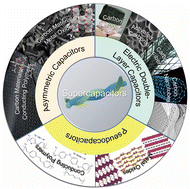
Transition metal-based electrode materials—particularly oxides (TMOs) and sulfides (TMSs)—have emerged as pivotal candidates for enhancing supercapacitor (SC) performance, addressing critical limitations in energy density, power density, and cycle stability. This comprehensive review systematically explores recent advancements in innovative TMO electrodes, including MnO2, NiO, ZnO, Co3O4, VOx, and RuO2, and TMS electrodes including binary/ternary sulfides (e.g., NiCo2S4 and CoMoS4). Key fabrication techniques, such as sol–gel processing, electrodeposition, hydrothermal synthesis, and chemical vapor deposition, are evaluated for their role in tailoring the material morphologies (e.g., nanosheets and core–shell heterostructures) and optimizing the electrochemical properties. The synergistic effects in hybrid composites (e.g., rGO/NiO-Mn2O3 and CNT@MnO2) significantly enhance the conductivity, ion diffusion, and faradaic redox activity, achieving remarkable specific capacitance (up to 1529 F g−1 for ZnO@Ni3S2) and retention rates (e.g., 91% over 500 cycles for NiO-Mn2O3@rGO). This review further contrasts TMOs and TMSs, highlighting the latter's superior electrical conductivity and reversible kinetics while noting the challenges in synthesis scalability and stability. Critical challenges, including low energy density, manufacturing costs, and industrial standardization, are discussed alongside future directions, such as flexible/wearable SCs, intelligent devices, and sustainable material design. This work underscores the transformative potential of transition metal-based electrodes in bridging the performance gap between capacitors and batteries, paving the way for next-generation energy storage systems.
- This article is part of the themed collection: 2025 Reviews in RSC Advances
 Please wait while we load your content...


