


 PLATFORM UPDATE:


Unveiling the catalytic potential of silicomolybdic acid in crafting diverse biologically relevant organic compounds
 a
Krishna
Kumar,
a
Subrato
Bhattacharya,
a
Tanay
Pramanik,
*b
Tanmoy
Roy
*c
and
Somenath
Garai
*a
a
Krishna
Kumar,
a
Subrato
Bhattacharya,
a
Tanay
Pramanik,
*b
Tanmoy
Roy
*c
and
Somenath
Garai
*a
Abstract
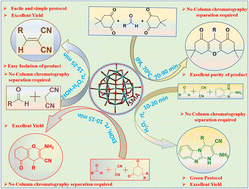
Silicomolybdic acid (SMA) is a widely explored heteropoly acid with key advantages, including easy recovery, safer handling, and strong acid strength. In this study, we report the first comprehensive application of SMA, a Keggin-type heteropoly acid, as an efficient and reusable Lewis acid catalyst for the synthesis of a range of oxygen- and nitrogen-containing heterocycles. The catalytic performance of SMA was demonstrated in the synthesis of biologically relevant chromene, imidazopyrimidine, xanthene, and benzylidene malononitrile derivatives via one-pot multicomponent reactions. All reactions proceeded under mild conditions using low catalyst loadings and environmentally benign solvents, affording excellent yields within short reaction times. A key advantage of this protocol is that it eliminates the need for column chromatography, enabling simple work-up and product isolation. Additionally, gram-scale synthesis and catalyst recyclability were successfully demonstrated, highlighting the practical utility of the method. Compared to existing protocols, this approach offers multiple benefits, including operational simplicity, shorter reaction durations, room temperature conditions, and high atom economy. Notably, SMA retained its catalytic activity over multiple cycles with minimal loss in efficiency. These findings establish SMA as a green, practical, and versatile catalyst for the sustainable synthesis of pharmacologically significant heterocycles, with strong potential for future broader applications in synthetic and medicinal chemistry.
 Please wait while we load your content...


