


 PLATFORM UPDATE:


Dynamic covalent interaction induced formation of a bortezomib–andrographolide complex and construction of the dual-drug delivery system
 *a
*a
Abstract
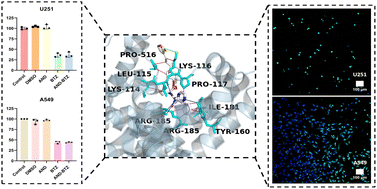
The interaction of boronic acids and 1,3-diols has significant application in tumour targeting and transcellular transfer, potentially to be employed in developing drug delivery systems. Bortezomib (BTZ), the dipeptide boronic acid analogue, is an FDA-approved anti-tumour drug. The hydrophobic boronic acid skeleton on BTZ resulted in unfavorable pharmacokinetic properties, which limits its efficacy for the treatment of solid tumours. Andrographolide (AND) holds significant potential for clinical application as a cancer treatment. The 1H and 11B NMR proved that BTZ-AND was formed via the interaction of a 1,3-diol moiety on AND with the boronic acid skeleton on BTZ. The CCK-8 tests suggested that BTZ-AND exhibited broad-spectrum anti-tumour effects on two types of solid tumours (U251 glioma cells and A549 cells). Additionally, BTZ-AND had a moderate binding affinity towards bovine serum albumin (BSA, the binding constant Ka as 1.16 × 10⁴ L mol−1 at 25 °C). Hydrophobic interactions are dominant in stabilizing the (BTZ-AND)-BSA complex due to the positive ΔH and ΔS, which was further proved by molecular docking results. These findings inspired us to develop the protocol for the delivery of BTZ-AND with BSA nanoparticles, which is capable of improving the pharmacokinetic properties, such as solubility and stability. When U251 glioma cells and A549 cells were treated with Ce6 labeled BTZ-AND@BSA NPs, it demonstrated notable potential in cellular uptake. Herein, we established a robust theoretical and experimental foundation for the advancement of dual drug delivery systems, presenting a promising basis for application in the treatment of solid tumours.
 Please wait while we load your content...


