


 PLATFORM UPDATE:


Enabling 3D electrical stimulation of adipose-derived decellularized extracellular matrix and reduced graphene oxide scaffolds in vitro using graphene electrodes
 †*a
Sandra I.
Vieira,
d
Bárbara M.
de Sousa,
d
Maria Teresa
Portolés,
fh
Bruno
Figueiredo,
i
Paula A. A. P.
Marques
*a
†*a
Sandra I.
Vieira,
d
Bárbara M.
de Sousa,
d
Maria Teresa
Portolés,
fh
Bruno
Figueiredo,
i
Paula A. A. P.
Marques
*a
Abstract
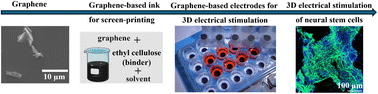
Notwithstanding the demonstrated benefits of electrical stimulation in enhancing tissue functionality, existing state-of-the-art electrostimulation systems often depend on invasive electrodes or planar designs. This work exploits the versatility of graphene to fabricate biocompatible electrodes for the three-dimensional in vitro electrical stimulation of neural stem cells. A conductive green graphene-based ink was formulated and screen-printed as the bottom and top electrodes in a bottom-less standard culture well plate. Upon exposure to macrophages, although some oxidative stress was observed, this graphene-based ink did not elicit an increase in the pro-inflammatory cytokine IL-6. An analysis of the electrode impedance as a function of time and frequency was performed to optimize the 3D electrical stimulation. The efficacy of these graphene electrodes for electrically stimulating cells across 3D environments was investigated in scaffolds composed of a decellularized extracellular matrix and reduced graphene oxide, which had previously shown the capability to facilitate neuronal differentiation in vitro and to create a pro-regenerative microenvironment in vivo. Neural stem cells were seeded on these scaffolds and electrically stimulated with a 10 Hz bidirectional current signal of 200 μA for 1 hour daily. At the target frequency of 10 Hz, deemed advantageous for neural regeneration, a scaffold impedance below 800 Ω was ensured. The low-frequency 3D stimulation proved to enhance cellular mechanisms essential for the development of neuronal networks, including neuronal differentiation, neuritogenesis and neurite growth.
 Please wait while we load your content...


