Issue 38, 2025, Issue in Progress

Isoniazid–rhodanine molecular hybrids: design, synthesis, antimycobacterial activity and computational validation

Abstract

A novel series of isoniazid–rhodanine (INH–Rh) molecular hybrids (9a–t) was prepared and structurally characterized using different spectroscopic techniques, including FTIR, NMR (1H, 13C, HMBC, and HSQC), and HRMS. All the hybrids (9a–t), including their precursors (3a–t and 8a–t), were assessed for their in vitro anti-tubercular activity, alongside the standard anti-tubercular drug, INH. Among them, 9d (MIC = 1.56 μg ml−1), 9j (MIC = 12.50 μg ml−1), and 9n (MIC = 12.50 μg ml−1) displayed the most potent activity against M. tuberculosis (Mtb), with 9d emerging as the most active. However, limited efficacy was observed for seven selected compounds (3h, 3i, 9d, 9j, 9l, 9n, and 9p) against INH-resistant Mtb strains harboring mutations in KatG. Moreover, the Mtb strain overexpressing the enoyl acyl carrier protein reductase (InhA) exhibited significant resistance to 9d, 9j, and 9n, suggesting InhA as their likely target. Molecular docking studies revealed that the binding modes and key intermolecular interactions of the selected compounds closely resembled those of INH, a known inhibitor of InhA. ADME/T analysis indicated favorable pharmacokinetic and safety profiles for the synthesized compounds, while DFT calculations provided further insights into their global reactivity characteristics.
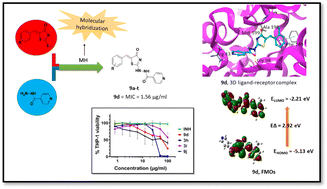
Graphical abstract: Isoniazid–rhodanine molecular hybrids: design, synthesis, antimycobacterial activity and computational validation

Supplementary files

Transparent peer review

To support increased transparency, we offer authors the option to publish the peer review history alongside their article.

View this article’s peer review history

Article information

Article type
Paper
Submitted
23 May 2025
Accepted
25 Aug 2025
First published
01 Sep 2025
This article is Open Access
Creative Commons BY-NC license

RSC Adv., 2025,15, 31272-31288

Isoniazid–rhodanine molecular hybrids: design, synthesis, antimycobacterial activity and computational validation

G. Kumar, S. Mishra, P. Seboletswe, N. Manhas, S. Ghumran, F. Roquet-Banères, L. Kremer, G. Bhargava and P. Singh, RSC Adv., 2025, 15, 31272 DOI: 10.1039/D5RA03641K

This article is licensed under a Creative Commons Attribution-NonCommercial 3.0 Unported Licence. You can use material from this article in other publications, without requesting further permission from the RSC, provided that the correct acknowledgement is given and it is not used for commercial purposes.

To request permission to reproduce material from this article in a commercial publication, please go to the Copyright Clearance Center request page.

If you are an author contributing to an RSC publication, you do not need to request permission provided correct acknowledgement is given.

If you are the author of this article, you do not need to request permission to reproduce figures and diagrams provided correct acknowledgement is given. If you want to reproduce the whole article in a third-party commercial publication (excluding your thesis/dissertation for which permission is not required) please go to the Copyright Clearance Center request page.

Read more about how to correctly acknowledge RSC content.

Social activity

Spotlight

Advertisements