


 PLATFORM UPDATE:

Electrochemical selection of a CFTR-specific aptamer and design of a COF-based aptasensor for the diagnosis of cystic fibrosis

Abstract
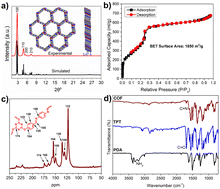
Cystic fibrosis (CF) is one of the most common life-shortening genetic diseases, affecting between 70 000 and 90 000 people worldwide. The gold standard in CF diagnostics is monitoring chloride concentrations in sweat samples. However, quantification of CFTR (cystic fibrosis transmembrane conductance regulator), the mutated protein in CF, plays a key role in early screening and tracking therapy effectiveness. Here, we report the selection of ssDNA aptamers targeting the CFTR protein via the SELEX (systematic evolution of ligands by exponential enrichment) process. After ten rounds of selection, three aptamers were generated, cloned, and sequenced. An electrochemical microarray was then developed to determine the affinity of the three sequences, CF1, CF2, and CF3. The CFTR protein was immobilized on a microarray composed of four carbon electrodes modified with gold nanoparticles. Mercaptoundecanoic acid and polyethylene glycol were used as linkers to provide a better orientation of CFTR molecules. Each CFTR-functionalized electrode was subsequently exposed to increasing concentrations of one of the three aptamers. The electrochemical response, monitored by differential pulse voltammetry (DPV), revealed that aptamer CF1 exhibited the best affinity, with a dissociation constant as low as 7.55 nM. In the second part of this work, we designed a voltammetric aptasensor based on covalent organic frameworks (COFs) to demonstrate the applicability of the selected aptamer for CF diagnosis. The proposed aptasensor showed very good analytical performance, with a low detection limit of 0.037 pg mL−1 and a wide linear range of 0.01–500 pg mL−1. High selectivity and applicability to spiked blood samples were also demonstrated.
 Please wait while we load your content...


