


 PLATFORM UPDATE:


Unveiling the role of structure–polarity interplay in non-ionic micellar catalyzed oxidative transformation of isoleucine: towards sustainable oxidation in aqueous media

Abstract
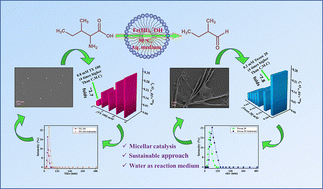
The oxidation of amino acids in environmentally benign systems represents a significant step toward greener synthetic methodologies. In this study, we report the first metal catalyst-free, micelle-mediated oxidation of isoleucine using potassium hexacyanoferrate(III) in alkaline aqueous medium, leveraging the catalytic potential of two non-ionic surfactants: Tween 20 and TX-100. This study underscores how subtle differences in micellar architecture, hydrophobicity, and interfacial polarity profoundly influence the reaction kinetics and substrate encapsulation. A comprehensive set of experimental techniques, including dynamic light scattering (DLS), 1H-NMR analysis, tensiometry, fluorometry, field emission scanning electron microscopy (FESEM) and time-correlated single photon counting (TCSPC), provide strong evidence supporting the analysis of the kinetic profiles. Additionally, FT-IR spectroscopy has been employed to characterize the functional groups present in the oxidized product, 2-methylbutanal, a flavour-active compound. Remarkably, Tween 20 exhibited a 7.8-fold rate enhancement at 0.2 mM (4 times its CMC) whereas TX-100 afforded only a 1.7-fold increase under comparable conditions. Menger–Portnoy's pseudo-phase model provided mechanistic insights, revealing a substantially higher binding constant (Ks = 8.985 mM−1) for Tween 20, suggesting stronger substrate–micelle affinity. DLS measurements corroborated more efficient encapsulation of isoleucine in the Tween 20 micellar system. The shorter average life time for the 0.2 mM Tween 20 system (∼5.7 ns) in TCSPC analysis also suggests that the probe molecule (pyrene) experiences a more polar and more flexible microenvironment. These findings highlight the critical role of surfactant microstructure in modulating catalytic efficiency and demonstrate the potential of non-ionic micellar media as tunable, green reaction platforms for amino acid oxidation. This work establishes a new paradigm in sustainable oxidation chemistry by replacing traditional metal catalysts with non-toxic surfactant-based systems, providing broad implications for green, sustainable synthesis and micellar catalysis.
 Please wait while we load your content...


