


 PLATFORM UPDATE:


Decoupled impact of acidity and mesoporosity on catalyst deactivation during glycerol dehydration over ZSM-5 zeolites

Abstract
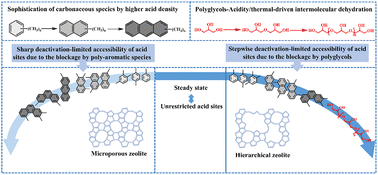
Catalytic glycerol dehydration to acrolein is an attractive value-added route for the reasonable utilization of bio-derived glycerol. ZSM-5 zeolites have been widely investigated in glycerol dehydration due to their initial catalytic performance and environmentally benign nature. However, ZSM-5 zeolite-based catalysts suffer from rapid deactivation. It is known that the acidity and porosity of the ZSM-5 zeolites influence the reaction. However, due to the interdependence and interplay between the acidity and porosity of zeolite, it is challenging to understand their respective roles in this reaction. Herein, the acidity and porosity of ZSM-5 zeolites are decoupled to investigate the separate roles and their interplay in the dehydration of glycerol. It is demonstrated that the accessibility of the acid sites is critical to the catalytic performance of the dehydration of glycerol. In this regard, the activity profile of microporous ZSM-5 zeolites with limited accessibility to the acid sites is characterised by a sharp decline from the beginning of the reaction, despite possessing the highest acid site density. The accessibility of the acid sites can be mitigated with hybrid mesoporosity. As a consequence, the acid sites at the low density level (only ca. 7% of the reference value of microporous ZSM-5) enable smooth running and high conversion (∼95%) of the reaction within 10 hours on the hierarchical ZSM-5 zeolites. However, the fast deactivation remains a challenge for the hierarchical ZSM-5 zeolites after the initial steady dehydration of glycerol. It is worth noting that the deactivation of the zeolite is not solely due to the blockage by carbonaceous species. Along with the progress of the dehydration reaction, the accessibility of the acid sites re-emerges as the factor responsible for the decline of the activity over the hierarchical zeolite, which stems from blockage by polyglycols due to the thermal or acid-driven intermolecular dehydrations. These observations enrich our fundamental understanding of the deactivation of the glycerol dehydration reaction and are informative for the emergence of refinement strategies to mitigate the deactivation bottlenecks.
 Please wait while we load your content...


