


 PLATFORM UPDATE:


Biomimetic MXene/wood hierarchical superamphiphobic films for solar-activated deicing and EMI shielding
Abstract
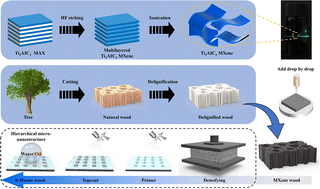
Ice accumulation poses significant threats to safety and energy efficiency across aerospace, energy, and transportation sectors. While conventional active de-icing methods suffer from high energy demands and environmental concerns, passive superhydrophobic surfaces offer limited ice prevention. To overcome these limitations, this study develops a robust, multifunctional photothermal superamphiphobic composite by integrating MXene (Ti3C3Tx) nanosheets with densified wood substrates and a gradient hierarchical coating. Delignified wood exposes hydrophilic cellulose nanofibers, enabling uniform MXene loading (up to 40 wt%) via drop-casting. Densification compresses MXene/wood, enhancing hydrogen bonding, thermal conductivity (photothermal heating rate: 4.9 °C s−1), and electromagnetic interference (EMI) shielding (80 dB at 40% MXene). A sequentially sprayed resin-based primer (with nylon microparticles) and a fluorinated silica nanoparticle topcoat create a micro–nano hierarchical gradient superamphiphobic (SAP) surface, achieving contact angles of >150° for water and oils, low adhesion, and self-cleaning functionality. Under 1-sun illumination, the composite rapidly melts ice within 60 s at −10 °C. The material also exhibits high mechanical strength (253.6 MPa after densification; 155–173 MPa post-coating) due to interfacial hydrogen bonding and structural integrity. This work presents a sustainable, active–passive anti-icing strategy with dual functionality in photothermal de-icing and EMI shielding, leveraging renewable wood resources and efficient MXene photothermal conversion.
 Please wait while we load your content...


