


 PLATFORM UPDATE:


Amide-substituted cyanostilbene-pyridine macrocycle: a “turn-on” fluorescent probe for detection of the herbicide quizalofop-p-ethyl
 *ac
*ac
Abstract
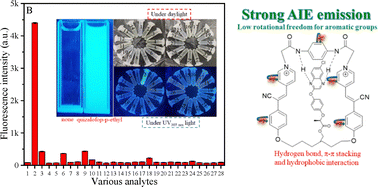
Although the herbicide quizalofop-p-ethyl is used widely in agriculture, it poses a risk to environmental safety and human health. The development of a simple, rapid and in situ detection method for quizalofop-p-ethyl is extremely necessary. In this work, a novel amide-substituted cyanostilbene-pyridine macrocycle (AS-CPM) was designed and synthesized as an effective fluorescent sensor for detecting quizalofop-p-ethyl. AS-CPM displayed a weak fluorescence in DMSO–H2O solution (5 : 95) but showed a strong blue fluorescence on sensing quizalofop-p-ethyl with high selectivity from among 28 kinds of herbicides and ions. The limit of detection was as low as 1.12 × 10⁻⁸ M, which is the smallest LOD obtained among the fluorescence sensors for sensing quizalofop-p-ethyl. A sensing mechanism was proposed, which revealed that quizalofop-p-ethyl was bound in the cavity of AS-CPMvia the strong intermolecular action of hydrogen bonds, π–π stacking and hydrophobic effects, which resulted in a stronger aggregation effect and better AIE properties. The reliability of AS-CPM for detecting quizalofop-p-ethyl was evaluated using test paper experiments, agricultural products, and water samples, which suggested the quantitative and qualitative application potential of this simple and rapid in situ method for the detection of quizalofop-p-ethyl in real samples and environments.
 Please wait while we load your content...


