


 PLATFORM UPDATE:


Optimal construction of Co3O4/Cu2O photo-assisted electrodes for aqueous Zn-ion hybrid capacitors: performance and mechanism
 *ab
*ab
Abstract
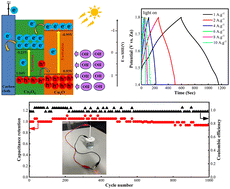
Co3O4, with a high theoretical capacitance, is a promising electrode material for energy storage devices. However, the poor conductivity, low reaction activity and sluggish reaction kinetics of Co3O4 constrain its performance. Herein, light irradiation is employed to improve the electrochemical performance of Co3O4 as a cathode material in zinc ion hybrid capacitors (ZIHCs). To strengthen the favorable effect of light irradiation, Cu2O is coupled with Co3O4 to construct a heterojunction, which enhances the separation and transfer of photo-induced charge carriers, thereby improving the conductivity, reactivity and reaction kinetics of materials. Two different heterojunction structures are constructed, and their photoelectric properties and photo-assisted charging performance are investigated. The optimal Co3O4/Cu2O electrode (OC2) shows a specific capacitance of 793.0 F g−1 at a current density of 4 A g−1 under illumination, which is 77.2% higher than that in the dark and is 3.7 and 10.2 times the capacitance of pristine Co3O4 and Cu2O, respectively. The mechanism analysis provides theoretical support for the photo-enhanced electrochemical performance of OC electrodes. The constructed OC2//Zn capacitor exhibits a high energy density of 255.3 Wh kg−1 and an excellent power density of 15.9 kW kg−1 under illumination. The device also demonstrates long-term stability with a capacity retention of 93.6% after 1000 cycles.
 Please wait while we load your content...


