


 PLATFORM UPDATE:


A study on the third-order nonlinear optical properties of pure KMnO4 using the CW Z-scan technique

Abstract
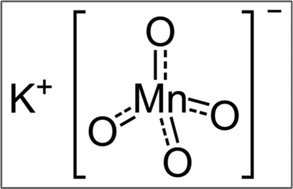
Potassium permanganate (KMnO4) is a remarkably versatile compound with a wide range of applications spanning from household to industrial settings. As a neutral salt, it possesses potent oxidizing properties that make it indispensable in various fields. The third-order nonlinear optical properties of pure KMnO4 solution with different normality of 0.05 N, 0.0166 N, 0.0125 N, and 0.009 N have been studied using the Z-scan technique with a continuous wave diode pumped solid state (DPSS) 532 nm laser source of 100 mW. By evaluating the closed aperture and the open aperture response, the nonlinear refractive index (n2) and the nonlinear absorption coefficient (β) were determined for different normality of KMnO4 solution. Also, using the values of n2 and β, the third-order nonlinear susceptibility (χ3) was discovered. The normality versus nonlinear refractive index has been assessed by plotting a curve. The closed aperture response reveals the negative sign of the nonlinear refractive index, which indicates the self-defocusing behavior, and the open aperture response demonstrates the reverse saturable absorption (RSA) mechanism. The thermal nature of the KMnO4 was found by the order of magnitude of the nonlinear refractive index (n2) and also by investigating the peak-valley separation values. The studies led to further investigation in the field of optical switching.
 Please wait while we load your content...


