


 PLATFORM UPDATE:


Enhanced adsorption of an organic dye by phyto-synthesized CuO nanoparticles derived from Malva sylvestris for sustainable environmental remediation
 ad
Khalid M.
Omer
*bc
and
ad
Khalid M.
Omer
*bc
and
Abstract
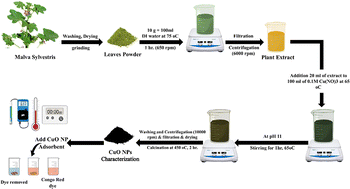
This study presents the green synthesis of copper oxide (CuO) nanoparticles using Malva sylvestris extract as a biogenic reducing and stabilizing agent, offering an eco-friendly and sustainable route to nanoparticle production. The synthesized CuO nanoparticles were thoroughly characterized through advanced analytical techniques to elucidate their morphology, crystalline structure, and surface properties. These nanoparticles were subsequently employed as an efficient adsorbent for the removal of Congo red dye from aqueous solutions. The adsorption process was systematically optimized by investigating the effects of pH, contact time, adsorbent dosage, and initial dye concentration. Kinetic studies indicated that the adsorption followed a pseudo-second-order model (R2 = 0.9997), suggesting that chemisorption was the predominant mechanism. Equilibrium data showed excellent correlation with both Langmuir and Freundlich isotherm models (R2 > 0.99), implying the coexistence of monolayer and multilayer adsorption processes. Thermodynamic parameters revealed that the adsorption was spontaneous and exothermic (ΔH° = –34.35 kJ mol−1), accompanied by reduction in entropy (ΔS° = –106.46 J mol−1 K−1), supporting a combination of physical and chemical adsorption mechanisms. The CuO nanoparticles demonstrated a maximum adsorption capacity of 6.99 mg g−1 for Congo red under optimized conditions: 4 ppm dye concentration, pH 7.0, temperature 20 °C, and 0.02 g adsorbent per 10 mL solution, achieving equilibrium within 30 minutes. The CuO nanoparticles retained over 78% of their adsorption efficiency after four regeneration cycles, highlighting their reusability and potential for long-term applications. Overall, the findings underscore the significant adsorption capability and environmental compatibility of phyto-synthesized CuO nanoparticles, positioning them as a promising candidate for sustainable wastewater treatment technologies.
 Please wait while we load your content...


