


 PLATFORM UPDATE:


Harnessing germanium from industrial residues and electronic waste for a sustainable energy future
 *ab
*ab
Abstract
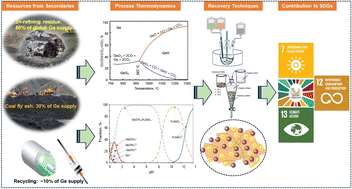
Traditionally, germanium has been a critical dopant in the silica core of fiber optics, facilitating high-speed internet and data transfer, and functions as a semiconductor in N-type diodes. Over the past decade, its importance has greatly expanded to multi-junction solar cells, where it serves as a substrate, providing a foundation for other semiconductor layers. Despite rising demands from renewable energy and semiconductor industries, germanium has no primary ores and is found only as a companion element with others. It is primarily sourced as a by-product from industrial residues like zinc refinery residues (ZRR) and coal burnt fly-ash (CFA), with concentrations ranging between 0.04–0.5% and 0.05–1.7%, respectively. Given the scarcity of germanium, its recovery through recycling of electronic waste is also gaining interest. However, the recovery process from both primary and secondary sources is complex, involving several key steps to ensure efficient extraction. Therefore, a comprehensive understanding of these processes, along with thermodynamic strategies applied to different materials, is essential. Consequently, this review covers germanium recovery from major primary and secondary resources, involving leaching, solvent extraction, ion exchange, and precipitation methods, with a focus on the underlying thermodynamics. Additionally, the environmental impacts of different extraction schemes are assessed using life-cycle analysis, revealing the global warming potential (GWP) of 852 kg CO2-eq for ZRR and 698 kg CO2-eq for CFA. In contrast, recycled germanium exhibits a much lower GWP of 163 kg CO2-eq, highlighting the importance of recycling efforts in advancing Sustainable Development Goals 7, 12, and 13.
- This article is part of the themed collections: 2025 Green Chemistry Hot Articles and 2025 Green Chemistry Reviews
 Please wait while we load your content...


