


 PLATFORM UPDATE:

Sustainable antimicrobial packaging films: effectiveness of epsilon-poly-l-lysine in PLA/PBAT blend films
 *a
*a
Abstract
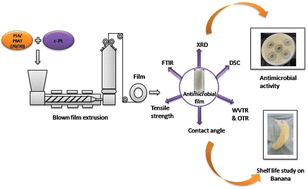
With the rising demand for environmentally friendly and sustainable food packaging solutions, there is growing interest in developing advanced compostable polymers with improved functional attributes. However, compostable polymers such as polylactic acid (PLA) exhibit certain drawbacks such as brittleness, which limit their application in flexible packaging. A promising strategy to address these limitations is blending PLA with polybutylene adipate terephthalate (PBAT), resulting in a compostable blend with well-balanced properties. The present work aims to develop active packaging films using PLA/PBAT blends, with the inclusion of different amounts (1–5 wt%) of the natural antimicrobial compound ε-poly-L-lysine (ε-PL). The films were produced using twin-screw blown film extrusion and evaluated for their mechanical, morphological, barrier and antimicrobial properties. The presence of ε-PL within the PLA/PBAT matrix was verified by Fourier-transform infrared spectroscopy (FTIR) analysis, which revealed characteristic absorption peaks in the 1500–1600 cm−1 range. Surface morphology represents heterogeneous dispersion of ε-PL in the PLA/PBAT matrix. Contact angle analysis revealed a progressive increase in surface hydrophilicity with higher ε-PL content, decreasing from 61.72° to 47.73°. X-ray diffraction (XRD) showed a reduction in crystallinity as the ε-PL concentration increased, while differential scanning calorimetry (DSC) provided insights into thermal transitions. Incorporation of ε-PL in the polymer blend led to a reduction in both oxygen and water vapor barrier properties. The antimicrobial effectiveness of the films was assessed against Staphylococcus aureus, with the 5 wt% ε-PL film exhibiting antibacterial activity (30.6 mm zone of inhibition). Release kinetics analysis indicated that ε-PL release followed Fickian diffusion, with the Higuchi model offering the best fit for the data (R2 = 0.98). When bananas were stored in PLA/PBAT blend films containing ε-PL, their quality was better maintained compared to both unpackaged bananas and those packed in control films. These findings suggest that PLA/PBAT films incorporated with ε-PL hold strong potential as more sustainable active packaging materials offering enhanced food safety and extended shelf life.
- This article is part of the themed collection: Celebrating International Women’s Day 2026: Women in Sustainable Food Technology
 Please wait while we load your content...


