


 PLATFORM UPDATE:


A tetradentate benzannulated P^N^N^P ligand and its Fe(ii) complex: synthesis, characterization, and electrocatalytic hydrogen evolution

Abstract
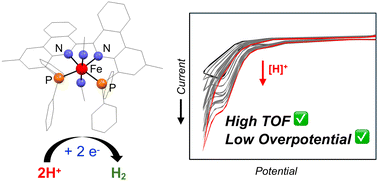
Iron complexes supported by phosphine and pyridine-based ligands are widely seen as efficient molecular catalysts for catalytic transformations, but examples of these complexes as molecular electrocatalysts for the hydrogen evolution reaction (HER) are limited. In this work, we present a ligand design based on a 6,6′-fused dimer of a 2,4-substituted (phosphino)phenanthridine (benzo[c]quinoline). Starting from the monomeric P^N precursor, we show how the P^N^N^P dimer can be selectively formed and report the synthesis and characterization of an Fe(II) complex of this unique scaffold. We demonstrate the potential of such frameworks in the electrocatalytic reduction of Brønsted acids in acetonitrile solution.
 Please wait while we load your content...


