


 PLATFORM UPDATE:


Photochromic macrocyclic complexes of yttrium(iii) undergoing merocyanine to spiropyran isomerization as models for single-molecule magnet switch candidates
 b
Louis
Caussin,
a
Yoann
Fréroux,
a
Thierry
Roisnel,
a
Boris
Le Guennic,
a
Stéphane
Rigaut,
a
Raphaël
Tripier
b
and
Lucie
Norel
*ac
b
Louis
Caussin,
a
Yoann
Fréroux,
a
Thierry
Roisnel,
a
Boris
Le Guennic,
a
Stéphane
Rigaut,
a
Raphaël
Tripier
b
and
Lucie
Norel
*ac
Abstract
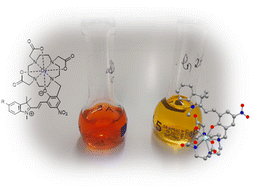
The synthesis and characterization of four macrocyclic yttrium(III) or dysprosium(III) complexes bearing a merocyanine photochromic unit are reported. The diamagnetic yttrium(III) complexes allowed for NMR investigation of both the equilibrium state and the photoinduced species, and they were also characterized using single-crystal XRD. We conclude from these studies that merocyanine is the more stable isomer in all the investigated solvents (methanol, acetonitrile, and dichloromethane) and in the solid state. Detailed structural investigations of isomerization to spiropyran appear to be challenging in solution as well as in crystals. Theoretical studies calculated large energy differences between the merocyanine and spiropyran isomers, which depend on the substitution of the photochromic unit by nitro groups. They also reveal that such designs would be well suited to construct photoswitchable single-molecule magnets, since the anisotropy of the dysprosium(III) complexes is significantly affected by the isomeric state of the ligand.
 Please wait while we load your content...


