


 PLATFORM UPDATE:


Mechanochemistry unlocking stoichiometric control in alkali metal carboxylate coordination polymers

Abstract
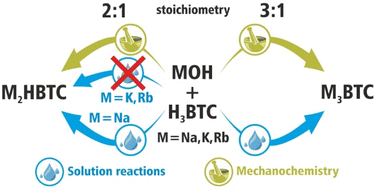
Alkali metal-based coordination polymers represent a promising alternative to transition metal systems, yet their development remains limited due to the inherent challenges in controlling and predicting the assembly of structures based on alkali cations. In this report we demonstrate a comprehensive study on the preparation of Na, K and Rb 1,3,5-benzenetricarboxylates using both self-assembly in an aqueous solution and the solid-state mechanochemical methods, revealing a remarkable degree of structural diversity in these seemingly simple systems. Notably, the developed mechanochemical procedures enabled excellent control over the metal-to-linker stoichiometry, as demonstrated by the selective formation of two M2HBTC-type phases (M = K, Rb; BTC = 1,3,5-benzenetricarboxylate), which were not readily accessible by solution-based synthesis. These results demonstrate the unique advantages of mechanochemistry in enabling stoichiometric control and accessing coordination polymers that remain out of reach for conventional solution-based methods.
 Please wait while we load your content...


