


 PLATFORM UPDATE:


Syntheses, crystal structures, and proton conduction properties of two zirconium fluorophosphonates

Abstract
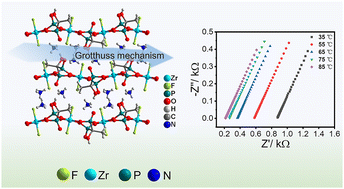
By introducing hydrogen fluoride (HF) and a competitive ligand into the synthetic system to enhance the crystallinity of products, two two-dimensional (2D) zirconium fluorophosphonate compounds with high crystallinity, namely A2[Zr(hedp)F2] (hedpH2 = 1-hydroxyethylidene-1,1-diphosphonic acid, A+ = K+ (1), NH4+ (2)), were successfully prepared. Their structures feature the anionic layer of [Zr(hedp)F2]n2n− with A+ cations located in interlayer spaces. The unique coexistence of F, –OH, and –PO3 moieties within the structure generates an extensive hydrogen-bonding network, facilitating efficient proton transport. At the temperature of 85 °C and the relative humidity (RH) of 95%, the proton conductivity (σ) of compounds 1 and 2 is 6.37 × 10⁻⁴ S cm−1 and 1.27 × 10⁻² S cm−1, respectively. The proton conductivities of both compounds follow the Grotthuss mechanism. Compound 2 demonstrates better proton conductivity owing to the presence of NH4+ cations, which facilitate the formation of extensive hydrogen-bonding networks that enable efficient proton transport. This study endows the zirconium fluorophosphate family with new members and provides a feasible research strategy for constructing highly crystalline metal fluorophosphonate compounds.
 Please wait while we load your content...


