


 PLATFORM UPDATE:


Improved thermal stability of ionic liquids through a hydrogen bond donor as an electrolyte for use in fluoride-ion batteries
 *b
Kohei
Miyazaki
a
and
*b
Kohei
Miyazaki
a
and
Abstract
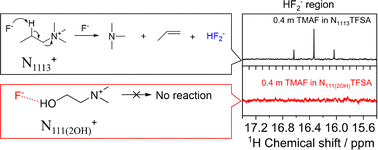
Next-generation batteries have become a trend in recent years and the fluoride-ion battery (FIB) is one among them. Electrolytes have played a crucial role in advancing the development of FIBs. Ionic liquids possess attractive properties as an electrolyte for FIBs, such as non-flammability, a wide electrochemical stability window and non-volatility. However, ionic liquids containing quaternary ammonium cations are unstable to the strong basic F− ion. In this work, the thermal stability of choline bis(trifluoromethanesulfonyl)amide (N111(2OH)TFSA), which contains a quaternary ammonium cation with a hydroxy functional group, was investigated as an electrolyte for FIBs. Solutions of 0.4 mol kg−1 tetramethylammonium fluoride (TMAF) in N111(2OH)TFSA were found to be stable up to 130 °C, based on the thermogravimetric analysis. Raman and 1H NMR analysis revealed that F− ions in the electrolyte were solvated by the OH functional group of the N111(2OH) cation. The thermal stability of the ionic liquid improved as the basicity of the F− ion decreased due to its solvation with the OH functional group. More importantly, the electrolyte demonstrated reversible defluorination and fluorination of BiF3 during electrochemical performance testing at 60 °C in a three-electrode cell.
 Please wait while we load your content...


