


 PLATFORM UPDATE:

Strategic functionalization of bromine and nitrogen at the bay region of perylene induces a heavy atom effect and promotes intersystem crossing

Abstract
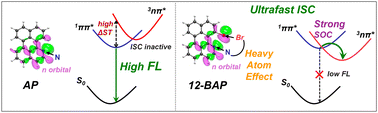
Spin–orbit coupling (SOC)-assisted intersystem crossing (ISC) plays a pivotal role in designing metal-free organic systems for optoelectronic applications. We computationally designed a new structural motif, i.e., 12-bromo-1-azaperylene (12-BAP), which incorporates three crucial factors that promote rapid ISC: a change in state character during singlet–triplet conversion (1ππ* → 3nπ*), a pronounced heavy atom effect (HAE), and a favourable energy alignment between the 1ππ* and 3nπ* states. Notably, the close spatial positioning of the heavy Br atom near the site of orbital angular momentum change intensifies the HAE. As a result, a strong SOC (89 cm−1) between the 1ππ* and 3nπ* states drives ultrafast ISC (1012 s−1). In contrast, azaperylene and its 12-hydroxy derivatives exhibit limited ISC efficiency owing to the higher energetic position of the 3nπ* state. Br substitution at the 12-position of 1-azaperylene yields the highest SOC and fastest ISC among all Br-substituted variants. Efficient triplet-state generation is crucial for the development of high-performance organic phosphorescent emitters and photodynamic therapeutic agents. The 12-BAP motif promotes ISC, providing a versatile scaffold for the rational design of functional organic materials.
- This article is part of the themed collection: Celebrating International Women’s day 2026: Women in physical chemistry
 Please wait while we load your content...


