


 PLATFORM UPDATE:

Effect of geometrical defects of hexagonal boron nitride nanosheets on the mechanical and tribological properties of PTFE composites: molecular dynamics simulations
 *a
*a
Abstract
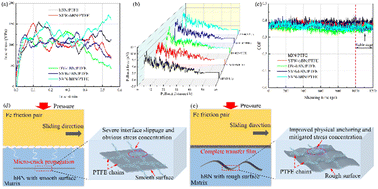
The surface defects of nanoparticles, as key controllable factors, provide important regulatory ideas for the directional design and optimization of composite material properties. Herein, the effect of four surface defects of hexagonal boron nitride (hBN) nanosheets on the mechanical and tribological performances of polytetrafluoroethylene (PTFE) is systematically investigated via molecular dynamics (MD) simulations. The uniaxial tensile and pull-out results show that the single vacancy of nitrogen atom (SVN)-defective hBN nanosheets possess the best enhancement effect on the tensile strength of PTFE, and can simultaneously improve the interfacial shear strength and fracture toughness of PTFE, which can be attributed to the synergism of the strengthened interfacial interaction, improved interfacial compatibility, and increased surface roughness. In addition, the tribological results demonstrate that the presence of surface defects is able to effectively improve the reinforcement effect of hBN nanosheets on the anti-friction and wear resistance of the PTFE. Meanwhile, among the four types of surface defects, the divacancy (DV)- and single vacancy of boron atom (SVB)-defective hBN nanosheets exhibit the best enhancement effects in terms of friction reduction and wear resistance, respectively, leading to the lowest coefficient of friction and abrasion rate. The collaborative enhancement mechanism of surface-defective hBN nanosheets is explored by calculating the microstructural evolution of the composites, such as interfacial interaction energy, von Mises stress distribution, and non-bond energy dissipation, etc. This work provides some theoretical guidance for the design and optimization of composite material properties by regulating the surface defects of nanoparticles.
 Please wait while we load your content...


