


 PLATFORM UPDATE:

Design of orthogonally jointed 2D transition metal dichalcogenide heterojunctions for enhanced photoelectrochemical water reduction
 c
and
Heng-Jui
Liu
*a
c
and
Heng-Jui
Liu
*a
Abstract
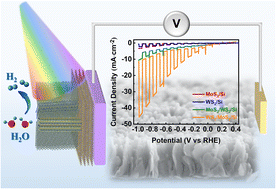
2D transition metal dichalcogenide (TMD) heterostructures are promising photoelectrode materials for photoelectrocatalysis due to their favorable band structures and chemical activity. Unlike conventional layered-stacked designs, this study explores orthogonally jointed WS2/MoS2 (orth-WS2/MoS2) and MoS2/WS2 (orth-MoS2/WS2) heterostructures grown on p-Si via RF magnetron sputtering by controlling TMD thickness. The orthogonal-connecting configuration exposes abundant edge sites, enhancing catalytic activity. Both heterostructures outperform individual MoS2 and WS2 in photoelectrochemical (PEC) water splitting, with orth-WS2/MoS2 achieving the highest photocurrent density. Band alignment analysis shows a staggered energy configuration in orth-WS2/MoS2/p-Si, promoting efficient charge separation. Additionally, theoretical calculations reveal that orthogonally jointed heterojunction has negative hydrogen adsorption energies, unlike their layered counterparts, which improves hydrogen evolution reaction (HER) kinetics. This work highlights a previously unexplored TMD-based heterostructure with enhanced solar water-splitting performance.
 Please wait while we load your content...


