


 PLATFORM UPDATE:


Near-infrared carbon dots enable ultra-sensitive fluorometric detection of belzutifan: a novel approach for real-time therapeutic drug monitoring in cancer treatment

Abstract
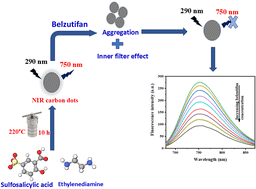
Belzutifan, a hypoxia-inducible factor-2α (HIF-2α) inhibitor, represents a breakthrough therapeutic agent for treating von Hippel–Lindau disease-associated tumors and advanced renal cell carcinoma, necessitating precise therapeutic drug monitoring. This work presents the first application of near-infrared carbon dots (NIR-CDs) for belzutifan detection utilizing a dual-mechanism approach combining aggregation-induced quenching and inner filter effect for enhanced analytical performance. The NIR-CDs were synthesized from sulfosalicylic acid and ethylenediamine precursors, exhibiting strong near-infrared emission at 750 nm upon 290 nm excitation with excellent photostability and pH tolerance. The developed fluorometric sensor demonstrated outstanding analytical performance with a linear detection range of 5.0–130.0 ng mL−1 and a limit of detection of 1.35 ng mL−1, which is approximately 103 to 104 times lower than therapeutic plasma concentrations. Plasma sample analysis showed excellent extraction recovery ranging from 96.6% to 98.1% across three concentration levels with relative standard deviations below 4.27%. The method demonstrated successful clinical validation through analysis of plasma samples from rats, achieving excellent correlation with reference LC-MS/MS methods while providing real-time therapeutic drug monitoring capabilities. This represents the first fluorometric approach for belzutifan quantification and establishes a new paradigm for anticancer drug monitoring that combines the advantages of carbon dot nanotechnology with clinically relevant near-infrared detection, offering significant potential for point-of-care therapeutic drug monitoring in oncology practice.
 Please wait while we load your content...


