


 PLATFORM UPDATE:


LEC-former: enhancing functional group identification in FTIR spectra by improving weak peak perception
 a
a
Abstract
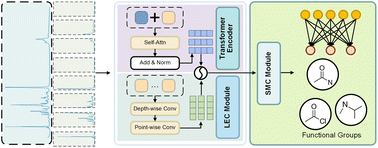
Fourier transform infrared (FTIR) spectroscopy is widely applied in chemical structure analysis and functional group identification, serving as an essential tool for the investigation of unknown compounds. Traditional rule-based or machine learning approaches in spectral analysis often rely on prominent characteristic peaks, while failing to effectively exploit potential weak features within spectral signals, thereby exhibiting limitations in functional group identification tasks. In this study, we propose a functional group recognition model, LEC-former, which enhances the representation of weak spectral peaks. The model employs a self-attention-based spectral peak coupling encoder to capture long-range dependencies among infrared spectral peaks, while an innovatively designed LEC module enhances fine-grained perception of local features. This enables reinforced representation of weak peaks and effective integration of discrete peak positions, thereby improving the identification of key spectral regions associated with target functional groups. In this study, 23 337 FTIR spectra from the NIST Chemistry WebBook were selected to construct a multi-label functional group recognition task. The proposed model was compared against mainstream machine learning models across multiple evaluation metrics. The results demonstrate that LEC-former achieves significant improvements in functional group recognition accuracy and exhibits outstanding performance in molecular exact match rate.
 Please wait while we load your content...


