


 PLATFORM UPDATE:

Detection of phosphates in water utilizing a Eu3+-mediated relay mechanism†

Abstract
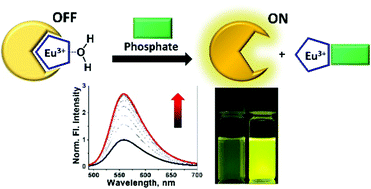
Three carboxamidequinoline ligands were synthesized and their complexes with Eu3+ were used for recognition and detection of organic/inorganic phosphates in water. The signal transduction process is based on an “On–Off–On” switch in the fluorescence signal utilizing changes in the intramolecular charge transfer (ICT). The fluorescence emission of ligands is quenched upon exposure to the Eu3+ (Off signal). Following the addition of the phosphate analytes the ligand–Eu3+ complex disassembles, which results in the regeneration of the original emission of the ligand (On signal). In general, the Eu3+ complexes show higher affinity towards adenosine 5′-triphosphate (ATP) and lower affinity to other phosphates, namely adenosine 5′-diphosphate (ADP), adenosine 5′-monophosphate (AMP), pyrophosphate (H2P2O72−, PPi), and dihydrogenphosphate (H2PO4−, Pi).
 Please wait while we load your content...


