


 PLATFORM UPDATE:


From centrosymmetric to noncentrosymmetric: effect of the cation on the crystal structures and birefringence values of (NH4)n−2AE(PO2F2)n (AE = Mg, Sr and Ba; n = 2, 3 and 4)†
 *ab
and
Shilie
Pan
*ab
*ab
and
Shilie
Pan
*ab
Abstract
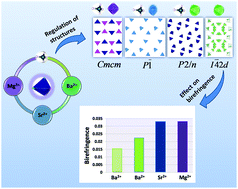
Fluorine-containing compounds significantly enrich the diversity of inorganic chemical structures. Here, four alkaline-earth metal difluorophosphates with different space groups, namely NH4Mg(PO2F2)3 (Cmcm) (1), NH4Sr(PO2F2)3 (P![[1 with combining macron]](https://www.rsc.org/images/entities/char_0031_0304.gif) ) (2), (NH4)2Ba(PO2F2)4 (P2/n) (3) and Ba(PO2F2)2 (I
) (2), (NH4)2Ba(PO2F2)4 (P2/n) (3) and Ba(PO2F2)2 (I![[4 with combining macron]](https://www.rsc.org/images/entities/char_0034_0304.gif) 2d) (4), were synthesized and their structures were determined for the first time. 4 is not only the first alkaline-earth-metal difluorophosphate, but also the first difluorophosphate reported to crystallize in the non-centrosymmetric space group I2d of the tetragonal crystal system. All of the three-dimensional (3D) structures of the title compounds consist of isolated (PO2F2)−, AE–O and NH4+ units, while the differences of the cation radius result in various arrangements of the (PO2F2)− units, which leads to diverse crystal structures and the disparate optical anisotropy of the crystals. According to the deep-ultraviolet (DUV) transmittance spectrum, 3 exhibits a short DUV cut off edge (<180 nm). Solid state 19F and 31P magic-angle spinning NMR spectroscopy was used to verify the presence of covalent P–F bonds in 3. The different size effects, as well as the coordination environments of the Mg2+, Sr2+, and Ba2+ cations, on the structures as a whole have been discussed in detail. In addition, the calculated birefringence values were observed to differ from 0.011 to 0.033 for the four compounds.
2d) (4), were synthesized and their structures were determined for the first time. 4 is not only the first alkaline-earth-metal difluorophosphate, but also the first difluorophosphate reported to crystallize in the non-centrosymmetric space group I2d of the tetragonal crystal system. All of the three-dimensional (3D) structures of the title compounds consist of isolated (PO2F2)−, AE–O and NH4+ units, while the differences of the cation radius result in various arrangements of the (PO2F2)− units, which leads to diverse crystal structures and the disparate optical anisotropy of the crystals. According to the deep-ultraviolet (DUV) transmittance spectrum, 3 exhibits a short DUV cut off edge (<180 nm). Solid state 19F and 31P magic-angle spinning NMR spectroscopy was used to verify the presence of covalent P–F bonds in 3. The different size effects, as well as the coordination environments of the Mg2+, Sr2+, and Ba2+ cations, on the structures as a whole have been discussed in detail. In addition, the calculated birefringence values were observed to differ from 0.011 to 0.033 for the four compounds.
 Please wait while we load your content...


