


 PLATFORM UPDATE:

Unravelling the microhydration frameworks of prototype PAH by infrared spectroscopy: naphthalene–(water)1–3†

Abstract
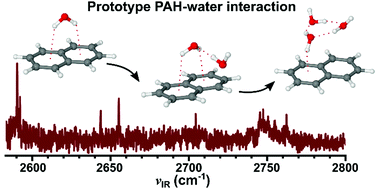
Hydration of aromatic molecules is a fundamental chemical process. Herein, microhydration framework of the prototypical neutral polycyclic aromatic hydrocarbon (PAH), naphthalene (naphthalene–(water)n≤3), is investigated by infrared spectroscopy inside helium nanodroplets. The measured data are analyzed by quantum chemical calculations at the MP2/6-311++G(d,p) level. This combined experimental and theoretical approach demonstrates that water binds to the naphthalene ring via π hydrogen bond (H-bond) for n = 1 case. Further addition of the solvent molecules occurs via the formation of a H-bonded water network facilitated by the nonadditive cooperative force. No isomers are observed in which the solvent molecules separately bind to the aromatic ring. For n = 3 case, we observe the formation of a cyclic H-bonded water moiety. Comparison with corresponding cationic and anionic naphthalene±–(water)n clusters demonstrates the charge-induced modification of the hydration motif. Our results are further compared with the prototypical benzene–(water)n complexes to comprehend the effect of an additional phenyl ring on the solvation network.
 Please wait while we load your content...


