


 PLATFORM UPDATE:

Largely enhanced photocatalytic hydrogen production rate of CdS/(Au–ReS2) nanospheres by the dielectric–plasmon hybrid antenna effect†
 *a
Qu-Quan
Wang
*ab
*a
Qu-Quan
Wang
*ab
Abstract
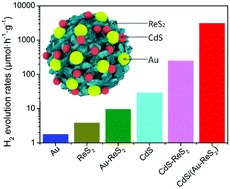
In this study, we synthesized CdS/(Au–ReS2) nanospheres that have highly efficient photocatalytic hydrogen production activity induced by dielectric–plasmon hybrid antenna resonance. As the diameter (D) of ReS2 nanospheres consisting of 2D nanosheets increases from 114 ± 11 to 218 ± 25 nm, the resonance wavelength of the ReS2 dielectric antenna is tuned from 380 to 620 nm and the hydrogen production rate for the CdS/(Au–ReS2) nanospheres increases by more than 1.85 times and reaches a value as high as 3060 μmol g−1 h−1, with a 9% weight percentage of Au. Due to the enhancements of the local electromagnetic field and excitation energy transfer by the ReS2–Au dielectric–plasmon hybrid antenna, the hydrogen production rate for the CdS/(Au–ReS2) nanospheres (D = 218 ± 25 nm) is 797, 319, 105 and 12 times larger than that for pure ReS2, Au–ReS2, CdS, and CdS–ReS2, respectively. Additionally, the persistence and reusability measurements indicate a favorable stability of CdS/(Au–ReS2). These results provide a strategy to prepare a new class of dielectric–plasmon hybrid antennas consisting of 2D materials and metal nanoparticles, which have promise in applications ranging from photocatalysis to nonlinear optics.
 Please wait while we load your content...


