



Electrodeposited high strength, thermally stable spectrally selective rhenium nickel inverse opals†
 *abce
*abce
Abstract
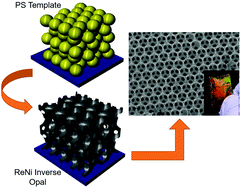
Rhenium–Nickel (RexNi100−x) based 3D metallic inverse opals (IOs) were realized via colloidal crystal templated electrodeposition from an aqueous electrolyte. By varying the electrodeposition parameters, x could be varied from 0 to 88. Under reducing conditions, the rhenium-rich IOs were structurally stable to temperatures of at least 1000 °C for 5 h and for at least 12 h after coating with a thin layer of Al2O3. This demonstrated level of thermal stability is significantly improved compared to previously reported electrodeposited refractory inverse opals with similar characteristic dimensions. A strong frequency dependence in the optical reflection, which ranged from ∼5% around 1.5 μm to ∼65% around 5 μm, is predicted by simulations and experimentally observed, indicating the potential of this structure as a high temperature spectrally selective optical absorber/emitter. The elastic modulus of the ReNi IO structure is ∼35 GPa and the hardness is ∼0.8 GPa. Both these properties are much higher than those of Ni inverse opals and other periodically porous materials with similar characteristic pore dimensions. We suggest this work provides a promising approach for thermally stable mesostructured materials for high temperature catalyst supports, refractory photonics and mechanical applications including high temperature filtration, and high temperature actuators.
 Please wait while we load your content...


