


 PLATFORM UPDATE:

Novel pH-sensitive drug carriers of carboxymethyl-hexanoyl chitosan (Chitosonic® Acid) modified liposomes
Abstract
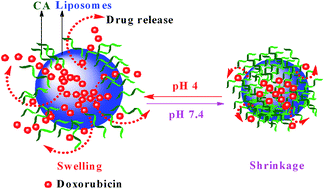
In this study, novel hybrid nanocarriers composed of carboxymethyl-hexanoyl chitosan (Chitosonic® Acid, CA) and 1,2-distearoyl-sn-glycero-3-phosphoethanolamine (DSPE)-liposomes were developed. CA was immobilized onto the DSPE-liposomes by EDC/NHS reaction using the carboxyl group of CA and the amino group of DSPE. The characteristics of the resultant CA-modified liposomes were evaluated by transmission electron microscopy, dynamic light scattering, zeta potential, FTIR spectroscopy, X-ray photoelectron spectroscopy, and contact angle measurement. The results show that the particle size and surface charge of the CA-modified liposomes varied with the concentration of CA, and exhibited pH-sensitive behavior. In vitro drug release studies demonstrated the sustained release behavior of the doxorubicin in the CA-modified liposomes, related to the rapid release in the free doxorubicin. Interestingly, the doxorubicin release rate from CA-modified liposomes was lower at higher pH values (pH 7.4) than at lower pH values (pH 4), indicating that the drug carrier displayed pH-sensitive released behavior. Furthermore, CA-modified liposomes exhibited no cytotoxicity toward the fibroblast cells (L-929 cells), suggesting an excellent biocompatibility. Fluorescence and confocal microscopy images showed good cellular internalization of the CA-modified liposomes into the cellular compartment. These results confirm that the novel CA-modified liposomes could respond to pH environment, which is promising for drug controlled release applications, especially in the field of cancer cell therapy (lower pH environments).
 Please wait while we load your content...


