


 PLATFORM UPDATE:


Aminopyridine derivatives controlled the assembly and various properties of Cu–BTC metal–organic frameworks†
Abstract
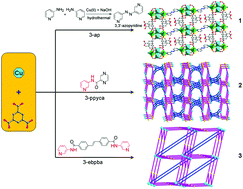
Three Cu(II) metal–organic frameworks (MOFs) based on 1,3,5-benzenetricarboxylic acid (H3BTC) and three aminopyridine derivatives with different lengths and coordination groups, namely [Cu2(3-azpy)(HBTC)(H2BTC)(μ3-OH)(H2O)2] (1), [Cu2(3-ppca)(BTC)(H2O)3]·H2O (2), [Cu2(3-ebpba)(BTC)(μ3-OH)] (3) [3-azpy = 3,3′-azopyridine, 3-ppca = N-(pyridin-3-yl)pyrazine-2-carboxamide, 3-ebpba = (E)-4,4′-(ethene-1,2-diyl)bis(N-pyridin-3-yl)benzamide)], have been hydrothermally synthesized and structurally characterized by elemental analyses, IR, PXRD, TG and single crystal X-ray diffraction analyses. The title MOFs display versatile structural features with 2D and 3D frameworks. Complex 1 exhibits a 2D layer, which is constructed from the 3-azpy bridging ligands and a 1D ladder-like Cu–BTC chain with tetranuclear copper clusters. The 3-azpy was in situ transformed from 3-aminopyridine under the hydrothermal conditions. Complex 2 shows a rare 3D framework, which features a (3,3,3,3)-connected topology with a Schläfli symbol of {8·10·12}2{82·10}2. Complex 3 exhibits a (3,8)-connected {4·62}2{42·622·7·83} topology based on tetranuclear copper clusters. The influence of aminopyridine-based ligands on the structures and properties of the title complexes has been discussed. The electrocatalytic and photocatalytic properties of complexes 1–3 have also been investigated in detail.
 Please wait while we load your content...


