


 PLATFORM UPDATE:


Stress induction, UV emission variation and efficiency variation in dye-sensitized solar cells of hollow ZnS/ZnO/ZnS nanostructures
Abstract
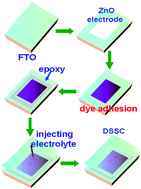
We synthesized a hollow ZnS/ZnO/ZnS nanostructure via a two-step chemical colloidal process. The structural and optical properties, and application of the samples were examined in detail. We found that a E2(high) mode with a red-shift of 6 cm−1 compared with original ZnO hollow nanostructure was induced in the Raman spectra. The red-shift of the E2(high) mode is attributed to stress induction in the hollow ZnS/ZnO/ZnS nanostructure. When the thickness of the ZnS nanoshell increases, a blue-shift UV emission band of approximately 6 nm is displayed in the room temperature photoluminescence spectra. The blue-shift of the UV emission band of the as-synthesized sample deteriorates when the thickness of the ZnS nanoshell becomes thicker. Although, the hollow ZnS/ZnO/ZnS nanostructure can help in increasing the optical path length within the electrode of dye-sensitized solar cells (DSSC) due to the multiple scattering of the ZnS–ZnO–ZnS interface. In this study, a low performance N719 DSSC was obtained. A possible reason for the lower performance of DSSC with a hollow ZnS/ZnO/ZnS nanostructure electrode is discussed.
 Please wait while we load your content...


