Lite Version|Standard version

To gain access to this content please
Log in via your home Institution.
Log in with your member or subscriber username and password.
Download

Optically active bicyclic β-lactams were synthesized, starting from 2-H-Δ2-thiazolines and Meldrum's acid derivatives. Several methods to accomplish an ester hydrolysis without damaging the β-lactam framework were investigated. A rapid CsOH saponification of the β-lactam methyl esters was developed and protonation of the Cs-carboxylates by Amberlite (IR-120 H+) afforded a series of bicyclic β-lactam carboxylic acids. Moreover, a convenient method for the synthesis of 2-H-Δ2-thiazolinecarboxylic acid methyl ester 2 was developed. Bicyclic β-lactam carboxylic acids 7a–g and aldehydes 4a–d were screened for their affinity to the bacterial periplasmic chaperone PapD using a surface plasmon resonance technique. β-Lactams substituted with large acyl substituents showed better binding to the chaperone than the native C-terminal peptide PapG 8, demonstrating that bicyclic β-lactams constitute a new class of potential bacterial chaperone inhibitors.
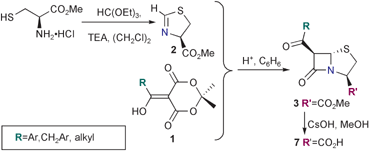
Graphical abstract: Stereoselective synthesis of optically active bicyclic β-lactam carboxylic acids that target pilus biogenesis in pathogenic bacteria

Page: ^ Top