


 PLATFORM UPDATE:


From lyotropic to thermotropic behavior: solvent-free liquid crystalline phases in polymer–surfactant-conjugated rod-shaped colloidal viruses
 *a
and
Eric
Grelet
*b
*a
and
Eric
Grelet
*b
Abstract
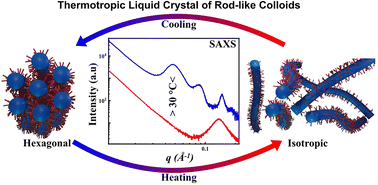
Filamentous bacteriophages fd are viral particles, highly monodisperse in size, that have been widely used as a model colloidal system for studying the self-assembly of rod-shaped particles as well as a versatile template in nanoscience. In aqueous suspensions, fd viruses exhibit lyotropic behavior, forming liquid crystalline phases as their concentration increases. Here, we report a solvent-free system displaying thermotropic phase behavior, achieved through covalent coupling of low molecular weight PEG-based polymer surfactant onto the fd virus surface. Upon lyophilization of aqueous suspensions of these polymer-grafted bacteriophages and subsequent thermal annealing, a solvent-free material is obtained, exhibiting both viscoelasticity and, notably, thermotropic liquid crystalline properties. A combination of small-angle X-ray scattering and optical microscopy experiments reveals the formation of an ordered hexagonal mesophase below 30 °C, which undergoes a melting transition into an isotropic liquid at higher temperatures. Our results demonstrate an efficient approach for converting lyotropic into thermotropic phase behavior in the columnar liquid crystalline phase of filamentous fd colloids. This approach paves the way for extending such functionalization to other technologically relevant rod-like systems, such as carbon nanotubes and cellulose nanocrystals, enabling the introduction of thermotropic properties in anhydrous colloidal materials.
 Please wait while we load your content...


