

 Open Access Article
 This Open Access Article is licensed under a
 Creative Commons Attribution 3.0 Unported Licence
Correction: A theoretical framework to understand high electron mobilities in cable bacteria
Andrew J.
Smith
a and
David N.
Beratan
*abc
aDepartment of Chemistry, Duke University, Durham, NC 27708, USA
bDepartment of Physics, Duke University, Durham, NC 27708, USA
cDepartment of Biochemistry, Duke University, Durham, NC 27710, USA. E-mail: andrew.smith@duke.edu; david.beratan@duke.edu
First published on 31st March 2026
Abstract
Correction for ‘A theoretical framework to understand high electron mobilities in cable bacteria' by Andrew J. Smith et al., Chem. Sci., 2026, 17, 5442–5450, https://doi.org/10.1039/D5SC04393J.
The authors recently discovered some errors in this publication that warrant correction and additional discussion, as detailed below.
1 Corrections
1.1 Main text
In Section 2.2 of the original paper, where the time convention m/k is discussed, the following statement should be added (referring to cable bacteria as CB):![[thin space (1/6-em)]](https://www.rsc.org/images/entities/char_2009.gif) “Although the convention of measuring elapsed time yields accurate results for CB (see correction Section 2), it is not valid for all systems.”
“Although the convention of measuring elapsed time yields accurate results for CB (see correction Section 2), it is not valid for all systems.”
The sentence:
“One-dimensional approximations to the hopping transport in arms of the CB may overestimate the mobility, because mobility drops with transport network dimensionality in periodic structures.”
should be replaced by:
“One-dimensional approximations to the hopping transport in CB may overestimate the mobility, since mobility decreases in the presence of obstacles (i.e., points where the particle is not free to move in the direction of interest).”
Effects attributed to dimensionality arise rather from the step-counting time convention when diffusion is projected onto a fixed direction. The following addition should be made at the end of Section 2.3:
“Using the definition of elapsed time as m/k suppresses errors that arise from coarse-graining (see correction Section 2).”
1.2 Supplementary information (SI)

The text:
“Performing an unbiased random walk on the short 3D fiber model and the short 1D fiber model produces a ratio of MFPTs  of 2.61. Applying the scaling ratio of MFPTs leads to a nearly identical range of possible carrier hopping parameter values (as shown in Fig. S7).”
should read:
“Performing an unbiased random walk with a time step equal to the mean escape time at each position along the trajectory, on the short 3D fiber model and the short 1D fiber model, produces a ratio of MFPTs  of unity. Since the MFPT ratio is unity, the finite 3D volume of the cable bacteria conduction channels likely has a small influence on the mobility, leading to an identical range of hopping parameters (seen in Fig. 6) for both 1D and 3D conduction channel cases.”
2 Addendum
2.1 Summary
The convention used in the original publication for measuring time in the random walks is not suitable for all structures. We used the convention that the time elapsed is t = m/k for m steps in a trajectory with hopping rate k (in reduced units, where k = 1, this amounts to counting steps to measure time). A more correct measure of time iswhere the sum on i runs over particle positions in the trajectory and the sum on j runs over the neighbors of site i (the mean escape time convention). To describe a system with hopping rates determined by Marcus-like theories, the mean escape time convention is more appropriate because each hopping rate is determined pairwise. Since each hopping rate is independent of the presence or absence of other hops, a particle should reside for a shorter time at a site with more neighbors. Conversely, the step counting method forces a particle to remain at all sites for the same time, regardless of the number of neighbors since Δt is fixed.

The ratios of mean first passage times (MFPTs) for cable bacteria (CB) and a one-dimensional (1D) chain derived from the two time-keeping approaches produce the same result. This occurs because the MFPT in the mean escape time convention (![[t with combining macron]](https://www.rsc.org/images/entities/i_char_0074_0304.gif) phys) may be related to the MFPT measured in step counts (steps) through an effective waiting time τ,
phys) may be related to the MFPT measured in step counts (steps) through an effective waiting time τ,
| phys = τsteps. |
The step-counting and mean-escape time conventions produce the same result when τCB/τ1D = 1.

For a periodic 1D chain, τ1D = 0.5 because each site has two neighbors. In the CB model that was used, each site had two or more neighbors, so τCB < 0.5. However, since most sites in a CB belong to fibers or to the spine (with two neighbors), rather than hubs and branch points with higher coordination, we show here that τCB ≥ 0.49. As

The more general formulation leads to small changes to the interpretation of the simulation data, detailed below. We have also recomputed many of the figures in the original publication using the mean escape time definition, and we find that the two conventions lead to the same conclusions (note that figures are labeled with the same number as in the original submission with an additional “-C” in the correction). The main change to the conclusions in the SI of the paper appears in Section S5, discussed in Section 1.2.2 of this correction. Section S5 reported that the non-1D structure of individual conduction pathways led to a factor of 2.61 increase in MFPT. This finding arose from differences in the effective waiting time and the use of the original step-counting time convention. When the mean escape time convention is used, the MFPT remains unchanged when the possible three-dimensional structure of individual conduction channels is considered, although the 1.5 fold increase in MFPT discussed in the main text, arising from the effect of junctions on multiple conduction channels, remains unchanged.
2.2 Primary differences between time-keeping conventions
Although Fig. 5 accurately describes the CB MFPT ratio, we include Fig. 5-C here to validate this result using the mean escape time convention. The figure shows that, when the mean escape time convention is used, the ratio depends on the number of coarse-grained beads used (which is inversely related to the bead diameter). Using 17 coarse-grained beads produces a ratio of 1.46, which lies within the combined error due to window size and the coarse-graining threshold (∼3.5%) of the originally reported value of 1.5. As in the original publication, open circles denote results obtained using a less stringent convergence threshold of θ = 0.01.
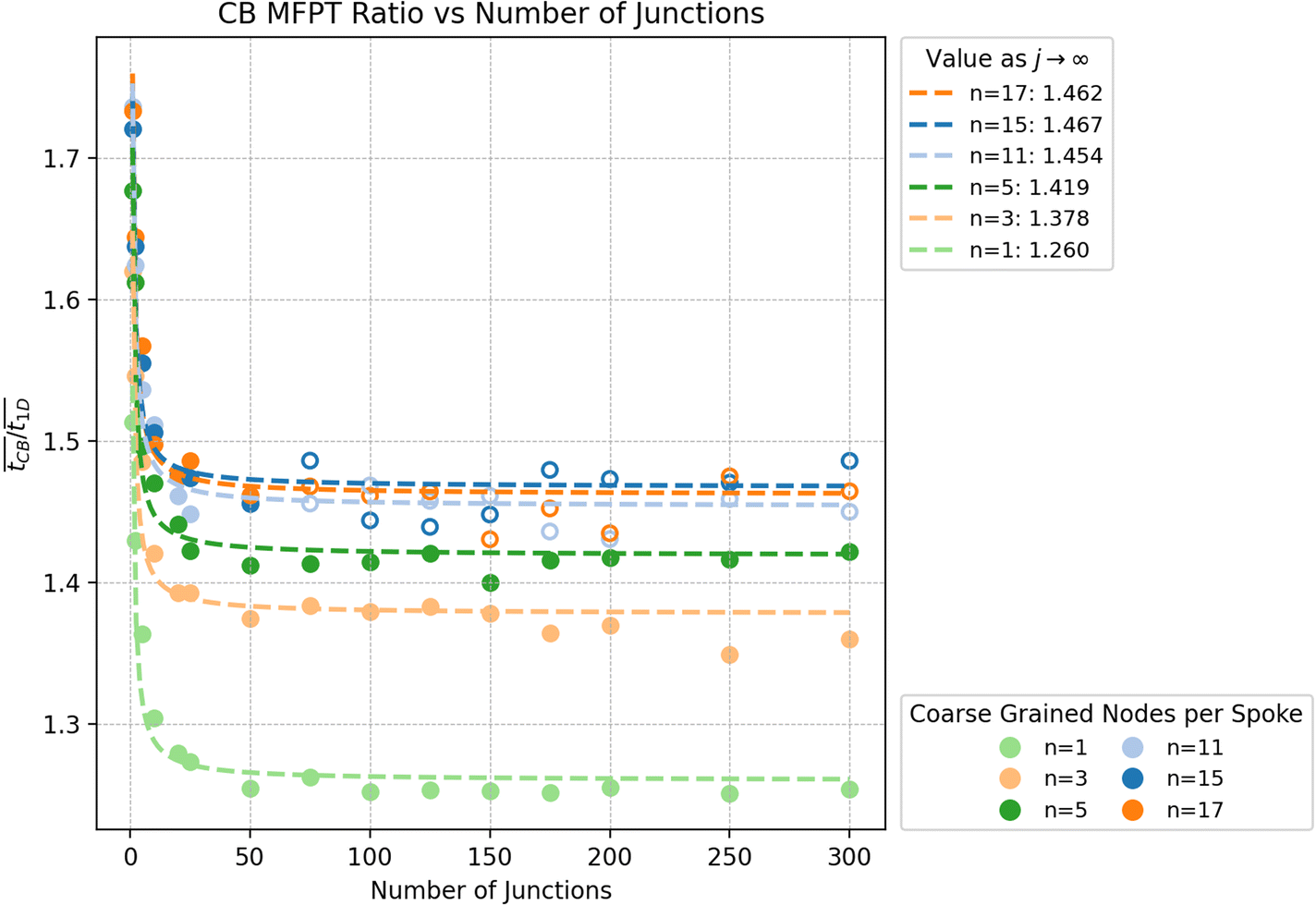

When the mean escape time convention is used to compute the MFPT in a CB model, the influence of the coarse-graining scale on the MFPT is substantially larger (>10%) than in the original publication (where it was ∼1%). This behavior is expected, since the effective waiting time depends on the distribution of coordination numbers in the CB model. The fraction of sites in a CB model with two neighbors varies with the coarse-graining diameter: decreasing the diameter increases the number of sites with two neighbors within each fiber and spoke, while the number of hubs and branch points (which have more than two neighbors) remains unchanged. One therefore needs to choose the coarse-graining scale to ensure that the number of neighbors assigned to each node in the coarse-grained model appropriately represents the number of neighbors each node has in the full system, thereby minimizing coarse graining error (see Fig. 5-C).
In the SI Section S4A, the ratio of MFPTs,  , only holds when the old step counting time convention is used. When the new mean escape time convention is used, this ratio is
  . Using the mean escape time convention results in Fig. S4-C.

2.3 Minor differences between time-keeping conventions


The Royal Society of Chemistry apologises for these errors and any consequent inconvenience to authors and readers.
| This journal is © The Royal Society of Chemistry 2026 |