


 PLATFORM UPDATE:


A unified mechanistic framework for DDQ-promoted transformation of electron-deficient alkenes: the addition-coupled electron transfer (ACET) perspective
 *a
and
*a
and
Abstract
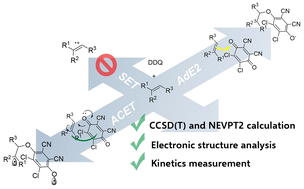
2,3-Dichloro-5,6-dicyanobenzoquinone (DDQ) is a widely used oxidant in organic chemistry, but the mechanism of DDQ-promoted transformation of electron-deficient alkenes has remained unclear. We elucidate a unified mechanistic framework for the reactions of DDQ with a diverse range of alkene substrates utilizing high-level computations and various experiments, including kinetics measurements, linear free energy relationships, and isotopic effects. Contrary to the prevailing SET paradigm, we demonstrate that these transformations are initialized by addition of DDQ to alkenes. Critically, this addition operates on a mechanistic continuum between classical electrophilic addition (AdE2) and a newly recognized elementary step termed addition-coupled electron transfer (ACET). A zwitterionic intermediate is generated in the AdE2 regime, while a biradical intermediate is generated in the ACET one by concurrent nucleophilic addition and electron transfer. The position of a reaction on the ACET–AdE2 continuum is governed by the electronic properties of alkene substrates and the extent of acid catalysis. By integrating high-level DLPNO-CCSD(T) and NEVPT2 calculations with multiple experimental probes, we provide a computational–experimental dissection of these mechanisms with state-of-the-art accuracy. Although DDQ is the focus here, this unified framework is not restricted to DDQ: the ACET–AdE2 continuum is likely general for a broad class of oxidants. Most importantly, this study deepens our understanding of ACET as a new elementary step in organic reactivity, using DDQ as a representative case. This work not only resolves the long-standing mechanistic ambiguity in DDQ-involved reactions but also challenges the prevailing SET dogma and establishes ACET as a general principle of chemical reactivity.
 Please wait while we load your content...


