Regiodivergent gold(I)-catalysed rearrangements in indole synthesis

Ana K. García-Dueñas a, Edson D. Hernández-Velázquez a, Jaime G. Ibarra-Gutiérrez a, Rafael Ortiz-Alvarado a, Jesús A. López d, Luis Chacón-García *b, Gabriel Merino *c, Fernando Murillo *c and César R. Solorio-Alvarado *a
aUniversidad de Guanajuato, Departamento de Química, División de Ciencias Naturales y Exactas, Campus Guanajuato. Cerro de la Venada S/N, 36040, Guanajuato, Gto., Mexico. E-mail: csolorio@ugto.mx
bUniversidad Michoacana de San Nicolás de Hidalgo, Facultad de Químico Farmacobiología, Tzintzuntzan 173, col. Matamoros, Morelia, Mich., Mexico. E-mail: lchacon@umich.mx
cDepartamento de Física Aplicada, Centro de Investigación y de Estudios Avanzados, Unidad Mérida. Km 6 Antigua Carretera a Progreso. Apdo. Postal 73, Cordemex, 97310, Mérida, Yuc., Mexico. E-mail: fernando.murillo@cinvestav.mx
dMicroRNAs and Cancer Laboratory, Universidad Autónoma de Zacatecas, Av. Preparatoria S/N, Agronómica, Campus II, Zacatecas, Zac. 98066, Mexico

Received 17th September 2025 , Accepted 11th November 2025

First published on 12th November 2025


Abstract

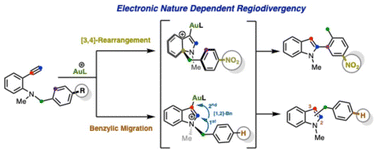
We report a regiodivergent gold(I)-catalysed cycloisomerisation of terminal 2-alkynyl anilines that yields either C2-o-tolylindoles via a [3,4]-sigmatropic rearrangement or C2/C3-benzylindoles via [1,2]-benzylic migration. The reaction selectivity is fully controlled by the electronic nature of the benzylic substituent. Under optimised conditions (10 mol% Au, DCE, 70 °C), substrates bearing strong electron-withdrawing groups (e.g., p-NO2) follow the [3,4] pathway to afford C2-o-tolylindoles in up to 95% yield and with regioselectivity ratios of up to 21[thin space (1/6-em)]:[thin space (1/6-em)]1. Phosphine-based catalysts provided the highest efficiencies and selectivities. Density functional theory calculations show that electron-withdrawing substituents raise the activation barrier for [1,2]-benzyl migration (>14 kcal mol−1), thereby favouring the [3,4] pathway. This approach enables a direct route to sterically hindered C2-o-tolylindoles, which are otherwise challenging to access through cross-coupling methods.

Introduction

Gold(I)-catalysed cycloisomerisations constitute well-established methods for the construction of heterocycles and the promotion of rearrangements under mild conditions.1–8 Among these, the synthesis of indole derivatives has attracted particular attention owing to the biological relevance and synthetic versatility of the indole framework.9 A prominent strategy involves the gold(I)-catalysed cyclisation of 2-alkynyl anilines, which provides access to structurally diverse indoles and reveals mechanistic aspects such as sigmatropic rearrangements. In these transformations, substituents on the aniline nitrogen often migrate to the C2 or C3 position of the indole. Reported migrating groups include methyl,10 allyl,11 sulfone,12 and, more recently, 2-diphenylthioether.13 However, examples involving benzyl migration remain scarce.14 To the best of our knowledge, the formation of C2-o-tolylindoles 4via [3,4]-sigmatropic rearrangement of terminal 2-alkynyl-anilines, accompanied by conversion of a methylene into a methyl group, has not been described.

Herein, we describe a regiodivergent gold(I)-catalysed rearrangement that proceeds either through a [3,4]-rearrangement shift or a [1,2]-benzylic migration, depending on the electronic characteristics of the substrate. Substrates bearing strongly electron-withdrawing groups, such as nitro groups, on the benzylic moiety preferentially undergo the [3,4]-rearrangement. In contrast, in the absence of such groups, the reaction yields a mixture comprising products from single and double [1,2]-benzylic migrations together with [3,4]-rearranged species. Density functional theory (DFT) calculations were performed to investigate the reaction pathways and rationalise the observed regioselectivity (Scheme 1).


image file: d5qo01326g-s1.tif
Scheme 1 Precedents of gold(I)-catalysed synthesis of functionalized indoles via C3 migration of groups bonded to nitrogen of the starting material.

Results and discussion

As part of our ongoing work on gold(I)-catalysed synthesis of nitrogen-containing heterocycles, including [1,4]-benzoxazines,15 and functionalised indoles with potential anticancer16 and non-steroidal anti-inflammatory activity,17,18 we prepared a series of 2-alkynyl anilines, including 1a, as model substrates. Cycloisomerisation of 1a under gold(I) catalysis produced an inseparable mixture of three indole derivatives: N-methyl-2-benzylindole (2a), N-methyl-3-benzylindole (3a), and a non-benzylic analogue N-methyl-2-o-tolylindole-2-o-tolylindole (4a, eqn (1)).
 
image file: d5qo01326g-u1.tif(1)

Formation of indoles 2a and 3a has been reported previously,14 but the generation of 4a from anilines of type 1a has no precedent. Access to indoles of type 4 is synthetically challenging, mainly because of steric congestion between the indole core and the adjacent phenyl ring. Conventional approaches usually require separate preparation of the two fragments followed by cross-coupling. In contrast, the direct synthesis of both C2- and C3-benzylic indoles through catalyst-controlled cycloisomerisation represents a more efficient strategy.

Given the unusual outcome of this reaction, we carried out a systematic study of its scope and mechanism. A range of 2-alkynyl anilines containing electron-donating and electron-withdrawing substituents on the benzyl ring were synthesised and subjected to gold(I)-catalysed cycloisomerisation using catalysts of differing electronic and steric properties (Table 1).

Table 1 Gold(I)-catalysed divergent cycloisomerisation of terminal 2-alkynyl-aniline 1a–g to get benzylic indoles 2/3a–g and o-tolylindoles 4a–g.a

image file: d5qo01326g-u3.tif

Entry R Example AuL+ Ratio Yieldb (%)
2 3 4
a Unless otherwise indicated, the reactions were carried out using 0.120 mmol of 1a–g, 10 mol% of gold(I) catalyst, at 70 °C in DCE (0.3 M). b Isolated yields for inseparable mixture of 2 + 3 + 4. c c.r.m. = complex reaction mixture. d 20 mol% of gold(I) catalyst.
1 –H a Cat1 2.6 5.2 1 90
2 –H a Cat2 1 1.4 1.4 90
3 –H a Cat3 2.5 3.7 1 88
4 –F b Cat1 2.2 1.7 1 80
5 –OMe c Cat1 c.r.m.c
6 –SMe d Cat1 2.8 1 0 60
7 –SOMe e Cat1 c.r.m.c
8 –CNd f Cat4 0 1 6.3 66
9 4-NO2 g Cat1 0 1 21.2 95


The reaction initially carried out in anhydrous dichloromethane produced multiple products in low yields. Changing the solvent to anhydrous DCE afforded a single product in excellent yield (over 90%, entry 1). The yield increased further when a nitro group was present as a substituent (over 95%, entry 9). Owing to these high yields and regioselectivity, no additional solvents were examined.

image file: d5qo01326g-u2.tif

Under optimised conditions (DCE, 70 °C, see SI) cycloisomerisation of 1a with the (2-biphenylyl)di-tert-butylphosphine-based gold(I) catalyst Cat1 predominantly yielded the C3-regioisomer 3a (entry 1). In contrast, the carbene-based complex Cat2 (with tetrafluoroborate as counterion) favoured formation of both 3a and the o-tolylindole 4a (entry 2). Replacement of the counterion with bis-triflimide in Cat3 led to a mixture of C2- and C3-indoles as major products (entry 3). The reproducibility of these outcomes confirmed that product distribution depends strongly on the catalyst. Further experiments at 70 °C revealed that higher temperatures decreased yields and increased decomposition, without improving regioselectivity.

To examine the influence of electronic effects, substrates bearing various substituents on the benzylic ring were studied. The fluorinated substrate 1b gave a product distribution similar to 1a with negligible regioselectivity (entry 4). Electron-donating groups produced distinct outcomes. The methoxy-substituted analogue gave a complex mixture of unidentified products (entry 5), whereas the thiomethyl derivative yielded 2d and 3d in a 2.8[thin space (1/6-em)]:[thin space (1/6-em)]1 ratio and 60% combined yield, with no detectable o-tolylindole 4d (entry 6). This represented the highest C2/C3 regioselectivity observed, favouring benzylic migration.

Electron-withdrawing substituents stabilised by resonance effects were also investigated. The sulfoxide-substituted substrate gave a complex mixture (entry 7), consistent with intermolecular oxygen transfer from the sulfoxide to the alkyne, a process known under gold(I) catalysis.19,20 In contrast, the nitrile-substituted compound 1f treated with catalyst Cat4 produced o-tolylindole 4f with good regioselectivity (6.3[thin space (1/6-em)]:[thin space (1/6-em)]1 over 3f) and no detectable 2f (entry 8). A nitro-substituted analogue afforded 4g almost exclusively (21.2[thin space (1/6-em)]:[thin space (1/6-em)]1 over 3g) in 95% yield, representing the highest selectivity observed.

These results show that the product distribution is strongly influenced by the electronic nature of the benzylic substituent. Electron-withdrawing groups promote o-tolylindole formation via a [3,4]-sigmatropic rearrangement, providing an efficient route to otherwise difficult-to-access compounds. In general, cycloisomerisation of terminal 2-alkynyl anilines yields mixtures of C2-, C3-, and o-tolylindoles, but regioselectivity can be directed towards o-tolylindole formation by incorporating strongly electron-withdrawing groups, such as nitro, at the benzylic position. Based on these findings, a catalyst screening (Table 1) was undertaken to optimise the yield of this selective transformation and to expand the substrate scope (Table 2).

Table 2 Optimisation of the gold(I)-catalysed regiocontrolled cycloisomerisation of 2-alkynyl-aniline 1g to obtain o-tolylindole 4g.a

image file: d5qo01326g-u4.tif

Entry AuL+ t (h) Yieldb,c (%)
a Unless other is indicated, the reactions were carried out using 0.1 mmol of 1g, 10 mol% of gold(I) catalyst, at 70 °C in DCE (0.3 M). b Isolated yields are reported. c No inert atmosphere. d dec = decomposition.
1 Cat2 24 83
2 Cat4 24 92
3 Cat5 24 64
4 Cat6 7 68
5 Cat7 24 decd
6 Cat8 7 60


Cycloisomerisation of 1g with the carbene-based catalyst Cat2 yielded 4g in 83% yield (entry 1). In comparison, Fu's phosphine-based catalyst Cat4[thin space (1/6-em)]21 provided 4g in 92% yield, comparable to Echavarren's catalyst Cat122,23 (95%, Table 1). Other phosphine-based catalysts, including CyJohnPhos,24tBuXPhos,25 MorDalPhos,26 and triphenylphosphine (Cat5–Cat8), gave significantly lower yields (entries 3–6) and were not pursued further. On this basis, Cat1 and Cat4 were selected for scope exploration.

With optimised conditions established, the scope and limitations of the gold(I)-catalysed regioselective cycloisomerisation were examined (Scheme 2). Varying the N-methyl substituent in 1g revealed that 1h (N-ethyl) afforded 4h in 89% yield with an excellent regioisomeric ratio (17[thin space (1/6-em)]:[thin space (1/6-em)]1 in favour of 4h over 3h), with no detectable C2-regioisomer. In contrast, 1i (N-n-propyl) gave a lower yield (45%) and selectivity (5.4[thin space (1/6-em)]:[thin space (1/6-em)]1), while 1j (N-n-butyl) produced 4j in 43% yield (rr = 8.7[thin space (1/6-em)]:[thin space (1/6-em)]1). These results indicate that increasing the N-alkyl chain reduced both yield and regioselectivity, although synthetically useful selectivity is maintained.


image file: d5qo01326g-s2.tif
Scheme 2 Scope exploration of gold(I)-catalysed regiocontrolled cycloisomerisation of terminal 2-alkynyl-aniline 1g–m to the get o-tolylindoles 4g–n. Unless other is indicated, the reactions were carried out using 0.12 mmol of 1g–n, 10 mol% of Cat1, at 70 °C in DCE (0.3 M); rr considering the ratio over C3-regioisomer which was determined by NMR. a[thin space (1/6-em)]20 mol% of Cat4 was used. rr = regioisomeric ratio.

The influence of substituents on the aniline ring was then examined. For 1k (o-NO2), 4k was obtained in 23% yield (rr = 5.0). The m-NO2 derivative (1l) did not react, even at higher catalyst loading and longer reaction times, indicating strong steric sensitivity.

Because electron-withdrawing groups favour formation of o-tolylindoles (4), a benzenesulfonyl-substituted substrate was tested and gave 4m in 86% yield (rr = 3.8[thin space (1/6-em)]:[thin space (1/6-em)]1). A bulky para-iodo-substituted benzylic analogue gave 4n in 85% yield (rr = 4.0). Also iodine substituent on the benzylic fragment gave similar results, affording the corresponding o-tolylindol 4n in 85% yield (rr = 4.0). In contrast, other derivatives, such as anilines with bromine on the aromatic ring (for nitro derivatives) or N-ethyl/n-propyl groups (for nitrile systems), produced complex mixtures without isolable products. Overall, these results define the reactivity trends and confirm that this transformation enables regiocontrolled access to o-tolylindoles and, in some cases, mixtures of C2/C3-benzylic indoles.

The formation of products 2a, 3a, and 4a from 1a under AuL+ catalysis (modelled as Cat1′, with t-Bu replaced by Me) was examined using DFT at the PCM-ωB97xD/def2-TZVP//PCM-ωB97xD/LANL2DZ level at 70° C (see SI for details). The solvent (DCE) was treated implicitly, and an explicit acetonitrile molecule was included to represent the coordination environment accurately.

Formation of 2a and 3a proceeds through a stepwise sequence (Fig. 1). Coordination of 1a to Cat1′via the alkyne gives intermediate 1a-1G = –18.6 kcal mol−1, Fig. 1A). Cyclisation through transition state 1a-TS1G = 12.4 kcal mol−1) forms vinylidene intermediate 1a-2, which undergoes conformational change via1a-TS2G = 5.9 kcal mol−1) to 1a-3. From this intermediate, a [1,2]-benzyl migration from N to C2 occurs via1a-TS3G = 22.4 kcal mol−1) producing the gold carbene 1a-4. A subsequent [1,2]-hydride shift (1a-TS4, ΔG = 11.3 kcal mol−1) gives 1a-5G = –78.2 kcal mol−1), and final conversion of 1a-5 to 2a with regeneration of AuL+ is slightly endergonic (Fig. 1A).


image file: d5qo01326g-f1.tif
Fig. 1 Gibbs energy profile of the formation of (A) 2a and (B) 3a from 1a.

Product 3a can form from 1a-4 through a concerted [1,2]-benzyl migration (2a-TS1, ΔG = 18.0 kcal mol−1, Fig. 1B), whose barrier is 6.7 kcal mol−1 higher than 1a-TS4, making this route less favourable. Formation of 2a-1 is exergonic (ΔG = −73.4 kcal mol−1) but remains 4.8 kcal mol−1 less favourable than 1a-5.

Formation of 4a initiates from 1a-3 (Fig. 2). Rotation of the benzyl group generates 3a-1via3a-TS1G = 6.2 kcal mol−1). A subsequent [1,2]-benzylic migration from N to C7a via3a-TS2G = 25.7 kcal mol−1) forms 3a-2. This barrier is only 3.3 kcal mol−1 higher than migration to C2 (1a-TS3), suggesting both pathways are accessible. 3a-2 then undergoes a [3,4]-sigmatropic rearrangement (3a-TS3, ΔG = 20.8 kcal mol−1), followed by a [1,2]-hydride shift (3a-TS4, ΔG = 7.2 kcal mol−1) and AuL+ migration (3a-TS5, ΔG = 11.8 kcal mol−1). Final aromatisation is solvent-assisted in two steps: proton abstraction by MeCN (3a-TS6, ΔG = 19.0 kcal mol−1), followed by proton transfer to the benzylic carbon (3a-TS7, ΔG = 1.4 kcal mol−1), releasing AuL+ (Fig. 2).


image file: d5qo01326g-f2.tif
Fig. 2 Gibbs energy profile of the formation of 4a.

For the p-NO2-substituted system (4g), the energy landscape differs significantly from that of the unsubstituted analogue. The cyclisation barrier (1g-TS1) increases slightly (ΔΔG = +0.6 kcal mol−1), whereas the conformational barrier (1g-TS2) decreases (ΔΔG = −3.1 kcal mol−1; Fig. S1). However, the [1,2]-benzyl migration to C2 (1g-TS3, ΔG = 36.7 kcal mol−1) is 14.3 kcal mol−1 higher than in 1a, effectively suppressing formation of 2g and 3g, even though subsequent steps remain energetically accessible (1g-TS4 = 11.1 kcal mol−1, 2g-TS1 = 19.5 kcal mol−1; Fig. S2).

In contrast, the pathway leading to 4g from intermediate 1g-3 proceeds with lower barriers (Fig. S2). The conformational rearrangement via3g-TS1 requires 7.9 kcal mol−1, followed by a [1,2]-benzyl migration to C7a through 3g-TS2G = 25.9 kcal mol−1), which is 10.8 kcal mol−1 lower than 1g-TS3 (see Fig. S1). Subsequent steps display moderately higher barriers than in the unsubstituted system: the [3,4]-sigmatropic shift (3g-TS3, ΔΔG = +1.7 kcal mol−1), the [1,2]-hydride shift (3g-TS4, ΔΔG = +4.8 kcal mol−1), and AuL+ migration (3g-TS5, ΔG = 11.5 kcal mol−1). The solvent-assisted aromatisation sequence (3g-TS6, 3g-TS7) proceeds with slightly lower barriers than for 4a, and overall product formation remains comparably exergonic (ΔΔGrxn = 0.3 kcal mol−1).

The overall mechanism features two key points of regiodivergence following the initial exergonic 5-endo-dig cyclisation and conformational rearrangement leading to intermediate 1a-3. From this stage, regiodivergent products arise through [1,2]-benzyl migration to adjacent carbon atoms. Migration from N to C7a generates the non-aromatic intermediate 3a-2, which undergoes a [3,4]-sigmatropic rearrangement via3a-TS3 to yield the dearomatised species 3a-3. A subsequent [1,2]-hydride migration (3a-TS4) forms intermediate 3a-4, followed by AuL+ migration to the benzylic methylene carbon (3a-5). Aromaticity is restored through two solvent-assisted proton transfer steps (3a-TS6 and 3a-TS7). All barriers along this [3,4]-sigmatropic pathway are compatible with the experimental conditions, consistent with the formation of product 4a. The same pathway accounts for the formation of 4g, which proceeds with similar activation energies.

For the unsubstituted benzyl systems, migration from N to C2 occurs via1a-TS3G = 22.4 kcal mol−1), producing 1a-4 and enabling formation of 2a and 3a. For the p-NO2-substituted substrate, this step requires a prohibitively high barrier (1g-TS3, ΔG = 36.7 kcal mol−1). Consequently, intermediate 1g-4, and consequently 2g and 3g, is not formed under the experimental conditions, directing the p-NO2 system exclusively towards 4gvia a regioselective [3,4]-sigmatropic rearrangement.

Summary and outlook

This study shows that gold(I)-catalysed cycloisomerisation of terminal 2-alkynyl anilines enables regiodivergent indole formation via substrate-controlled pathways. Strong electron-withdrawing groups at the benzylic position (for example nitro or nitrile) selectively promote a [3,4]-sigmatropic rearrangement, providing efficient access to sterically hindered C2-o-tolylindoles. To our knowledge, this transformation has not been previously described and is valuable given the limitations of conventional cross-coupling routes. In contrast, unsubstituted benzyl groups afford mixtures of C2- and C3-benzylindoles together with o-tolylindoles.

DFT calculations account for the observed regioselectivity: electron-withdrawing substituents raise the barriers for competing [1,2]-benzylic migrations (by >14 kcal mol−1), thereby favouring the [3,4]-pathway. Experimentally, o-tolylindoles were obtained in high yields (up to 95%) and with high regioselectivity (up to 21[thin space (1/6-em)]:[thin space (1/6-em)]1), and phosphine-based catalysts, including Fu's Cat4 and Echavarren's Cat1, provided the best outcomes.

The method shows reduced efficiency with N-alkyl chains longer than ethyl, complete inhibition by meta-nitro substituents consistent with steric constraints, and incompatibility with certain functional groups (such as methoxy and sulfoxide). Overall, these results establish a mechanistically informed and practical route to pharmacologically relevant indole scaffolds through the combined control of catalyst and electronic nature of the substrates.

Author contributions

Ana K. García-Dueñas and Edson D. Hernández-Velázquez: investigation, methodology. Jaime G. Ibarra-Gutiérrez and Jesús A. López: formal analysis. Rafael Ortiz-Alvarado and Luis Chacón-García: funding acquisition supervision. Fernando Murillo: theoretical (methodology, investigation). Gabriel Merino: writing – review and editing, visualization, supervision. César R. Solorio-Alvarado: investigation, methodology, project administration, supervision, validation and writing – original draft.

Conflicts of interest

There are no conflicts to declare.

Data availability

The data supporting this article have been included as part of the supplementary information (SI). Supplementary information containing full characterization, experimental details, copies of 1H, 13C, 19F and computational details are available. See DOI: https://doi.org/10.1039/d5qo01326g.

Acknowledgements

We are grateful to Conahcyt (Fordecyt–Pronaces/610286/2020) for financial support. We acknowledge the DCNE, the Department of Chemistry, and the National Laboratory UG–Conahcyt (LACAPFEM) at the University of Guanajuato. We thank Secihti for providing fellowships to A. K. G.-D., E. D. H.-I., and J. G. I.-G. The work carried out in Mérida was funded by Cinvestav. F. M. acknowledges support for his postdoctoral fellowship.

References

  1. E. Jiménez-Núñez and A. M. Echavarren, Gold-Catalyzed Cycloisomerisations of Enynes: A Mechanistic Perspective, Chem. Rev., 2008, 108, 3326–3350 CrossRef.
  2. R. Dorel and A. M. Echavarren, Gold-Catalyzed Reactions via Cyclopropyl Gold Carbene-like Intermediates, J. Org. Chem., 2015, 80, 7321–7332 CrossRef CAS.
  3. P. D. Nahide, J. O. C. Jiménez-Halla, K. Wrobel, C. R. Solorio-Alvarado, R. Ortiz-Alvarado and B. Yahuaca-Juárez, Gold(I)-catalysed high-yielding synthesis of indenes by direct Csp3–H bond activation, Org. Biomol. Chem., 2018, 16, 7330–7335 RSC.
  4. Y. Wei and M. Shi, Divergent Synthesis of Carbo- and Heterocycles via Gold-Catalyzed Reactions, ACS Catal., 2016, 6, 2515–2524 CrossRef CAS.
  5. N. Krause and C. Winter, Gold-Catalyzed Nucleophilic Cyclisation of Functionalized Allenes: A Powerful Access to Carbo- and Heterocycles, Chem. Rev., 2011, 111, 1994–2009 CrossRef CAS PubMed.
  6. C. H. M. Amijs, C. Ferrer and A. M. Echavarren, Gold(I)-catalysed arylation of 1,6-enynes: different site reactivity of cyclopropyl gold carbenes, Chem. Commun., 2007, 698–700,  10.1039/B615335F.
  7. J. S. Wei, S. Yang, Y. Wei, S. Shamsaddinimotlagh, H. Tavakol and M. Shin, Gold(I)-catalyzed cycloisomerization of alcohol or amine tethered-vinylidenecyclopropanes providing access to morpholine, piperazine or oxazepane derivatives: a carbene versus non-carbene process, Org. Chem. Front., 2023, 10, 1738–1745 RSC.
  8. H. Tavakol, Y. Wei and M. Shi, The Regioselectivity in the Gold-Catalyzed Cycloisomerization of Alcohols: a Full DFT Study on Carbene Versus non-Carbene Mechanism, Res. Chem. Intermed., 2025, 51, 295–309 CrossRef CAS.
  9. C. Ferrer and A. M. Echavarren, Gold-Catalyzed Intramolecular Reaction of Indoles with Alkynes: Facile Formation of Eight-Membered Rings and an Unexpected Allenylation, Angew. Chem., Int. Ed., 2006, 45, 1105–1109 CrossRef CAS.
  10. X. Zeng, R. Kinjo, B. Donnadieu and G. Bertrand, Serendipitous Discovery of the Catalytic Hydroammoniumation and Methylamination of Alkynes, Angew. Chem., Int. Ed., 2010, 49, 942–945 CrossRef CAS.
  11. K. C. Majumdar, S. Hazra and B. Roy, Gold-catalyzed heteroannulation and allyl migration: synthesis of highly functionalized indole derivatives, Tetrahedron Lett., 2011, 52, 6697–6701 CrossRef CAS.
  12. I. Nakamura, U. Yamagishi, D. Song, S. Konta and Y. Yamamoto, Gold- and Indium-Catalyzed Synthesis of 3- and 6-Sulfonylindoles from ortho-Alkynyl-N-sulfonylanilines, Angew. Chem., Int. Ed., 2007, 46, 2284–2287 CrossRef CAS PubMed.
  13. A. V. Mackenroth, P. W. Antoni, F. Rominger, M. Rudolph and A. S. K. Hashmi, Gold-Catalyzed [3,3]-Sigmatropic Rearrangement of ortho-Alkynyl-S,S-diarylsulfilimines, Org. Lett., 2023, 25, 2907–2912 CrossRef CAS.
  14. G. Li, X. Huang and L. Zhang, Platinum-Catalyzed Formation of Cyclic-Ketone-Fused Indoles from N-(2-Alkynylphenyl)lactams, Angew. Chem., Int. Ed., 2008, 47, 346–349 CrossRef CAS.
  15. L. A. Segura-Quezada, K. R. Torres-Carbajal, N. Mali, D. B. Patil, M. Luna-Chagolla, R. Ortiz-Alvarado, M. Tapia-Juárez, I. Fraire-Soto, J. G. Araujo-Huitrado, A. J. Granados-López, R. Gutiérrez-Hernández, C. A. Reyes-Estrada, Y. López-Hernández, J. A. López, L. Chacón-García and C. R. Solorio-Alvarado, Gold(I)-Catalyzed Synthesis of 4H-Benzo[d][1,3]oxazines and Biological Evaluation of Activity in Breast Cancer Cells, ACS Omega, 2022, 7, 6944–6955 CrossRef CAS PubMed.
  16. J. G. Ibarra-Gutiérrez, C. R. Solorio-Alvarado, L. Chacón-García, J. A. López, B. Y. Delgado-Piedra, L. A. Segura-Quezada, E. D. Hernández-Velázquez and A. K. García-Dueñas, Gold(I)-Catalyzed Synthesis of 2,2′-Biindoles via One-Pot Double Cycloisomerisation Strategy, J. Org. Chem., 2024, 89, 17069–17089 CrossRef.
  17. K. R. Torres-Carbajal, L. A. Segura-Quezada, R. Ortíz-Alvarado, R. Chávez-Rivera, M. Tapia-Juárez, M. I. González-Domínguez, A. J. Ruiz-Padilla, J. R. Zapata-Morales, C. de León-Solís and C. R. Solorio-Alvarado, Indomethacin Synthesis, Historical Overview of Their Structural Modifications, ChemistrySelect, 2022, 7, e202201897 CrossRef CAS.
  18. L. A. Segura-Quezada, C. Alba-Betancourt, L. Chacón-García, R. Chávez-Rivera, P. Navarro-Santos, R. Ortiz-Alvarado, M. Tapia-Juárez, J. V. Negrete-Díaz, J. F. Martínez-Morales, M. A. Deveze-Álvarez, J. R. Zapata-Morales and C. R. Solorio-Alvarado, Synthesis and Anti-inflammatory Effect of Simple 2,3-Diarylindoles. On Route to New NSAID Scaffolds, ChemistrySelect, 2024, 9, e202303803 Search PubMed.
  19. N. D. Shapiro and F. D. Toste, Rearrangement of Alkynyl Sulfoxides Catalyzed by Gold(I) Complexes, J. Am. Chem. Soc., 2007, 129, 4160–4161 CrossRef CAS.
  20. G. Li and L. Zhang, Gold-Catalyzed Intramolecular Redox Reaction of Sulfinyl Alkynes: Efficient Generation of α-Oxo Gold Carbenoids and Application in Insertion into R–CO Bonds, Angew. Chem., Int. Ed., 2007, 46, 5156–5159 CrossRef CAS PubMed.
  21. G. C. Fu, The Development of Versatile Methods for Palladium-Catalyzed Coupling Reactions of Aryl Electrophiles through the Use of P(t-Bu)3 and PCy3 as Ligands, Acc. Chem. Res., 2008, 41, 1555–1564 CrossRef CAS.
  22. C. R. Solorio-Alvarado and A. M. Echavarren, Gold-Catalyzed Annulation/Fragmentation: Formation of Free Gold Carbenes by Retro-Cyclopropanation, J. Am. Chem. Soc., 2010, 132, 11881–11883 CrossRef CAS.
  23. C. R. Solorio-Alvarado, Y. Wang and A. M. Echavarren, Cyclopropanation with Gold(I) Carbenes by Retro-Buchner Reaction from Cycloheptatrienes, J. Am. Chem. Soc., 2011, 133, 11952–11955 CrossRef CAS.
  24. S. Kaye, J. M. Fox, F. A. Hicks and S. L. Buchwald, The Use of Catalytic Amounts of CuCl and Other Improvements in the Benzyne Route to Biphenyl-Based Phosphine Ligands, Adv. Synth. Catal., 2001, 343, 789–794 CrossRef CAS.
  25. H. N. Nguyen, X. Huang and S. L. Buchwald, The First General Palladium Catalyst for the Suzuki–Miyaura and Carbonyl Enolate Coupling of Aryl Arenesulfonates, J. Am. Chem. Soc., 2003, 125, 11818–11819 CrossRef CAS.
  26. B. J. Tardiff and M. Stradiotto, Buchwald–Hartwig Amination of (Hetero)aryl Chlorides by Employing Mor-DalPhos under Aqueous and Solvent-Free Conditions, Eur. J. Org. Chem., 2012, 2012, 3972–3977 CrossRef CAS.

Footnote

These two authors contributed equally to this work.

This journal is © the Partner Organisations 2026
Click here to see how this site uses Cookies. View our privacy policy here.