

 Open Access Article
 This Open Access Article is licensed under a
 Creative Commons Attribution 3.0 Unported Licence
EES Batteries 2025 Outstanding Papers
We are proud to announce the launch of the EES Batteries Outstanding Papers. This is an opportunity to recognise the exceptional work published in the journal and celebrate the authors behind the work by selecting one Outstanding Article and one Outstanding Review each year.These papers are chosen from a shortlist compiled by the Editorial Office using a range of metrics. The journal's Editorial and Advisory Boards review and vote on these papers based on the science presented and the potential impact. The Editor-in-Chief selects the final winning papers, taking the Board members’ votes into account.
We are delighted to introduce the inaugural Outstanding Article and Outstanding Review. Please join us in congratulating the authors behind these exceptional contributions.
EES Batteries 2025 Outstanding Article
High-performance anode-less all-solid-state batteries enabled by multisite nucleation and an elastic networkJihoon Oh, Yeeun Sohn and Jang Wook Choi
“The Outstanding Article on anode-less all-solid-state batteries presents a particularly novel approach to addressing one of the key challenges in all-solid-state-batteries: non-uniform lithium nucleation.1The combination of multisite nucleation control and an elastic network is both conceptually innovative and experimentally convincing, and the work provides clear insights that are likely to influence future designs of high-energy-density solid-state battery systems”. – Ungyu Paik, Editor-in-Chief, EES Batteries

Which part of this paper do you think will have the greatest impact?
The most impactful aspect is the novel interlayer design that integrates a multisite nucleation strategy with an elastic interfacial network, enabling uniform lithium deposition and stable cycling even under the harsh conditions of anode-less all-solid-state batteries.
What was the most challenging part of completing this research?
The main challenge was simultaneously achieving interfacial stability and mechanical compliance, while maintaining the high energy density and long cycle life inherent to anode-less configurations.
What are the next steps for this research?
The next steps include further reducing the required stack pressure, scaling up to practical cell formats, and optimizing the interlayer chemistry to enhance long-term stability and manufacturability.
EES Batteries 2025 Outstanding Review
Principles and trends in extreme fast charging lithium-ion batteriesYu-Xing Yao, Lei Xu, Chong Yan and Qiang Zhang
“The Outstanding Review on extreme fast charging lithium-ion batteries offers a timely overview of the fundamental principles governing fast-charging behaviour, including kinetic limitations, interfacial stability, and materials-level design strategies.2Importantly, the paper goes beyond summarising existing work by clearly identifying current bottlenecks and future research directions, making it a highly valuable reference for researchers working on both academic and industrial fast-charging applications”. – Ungyu Paik, Editor-in-Chief, EES Batteries
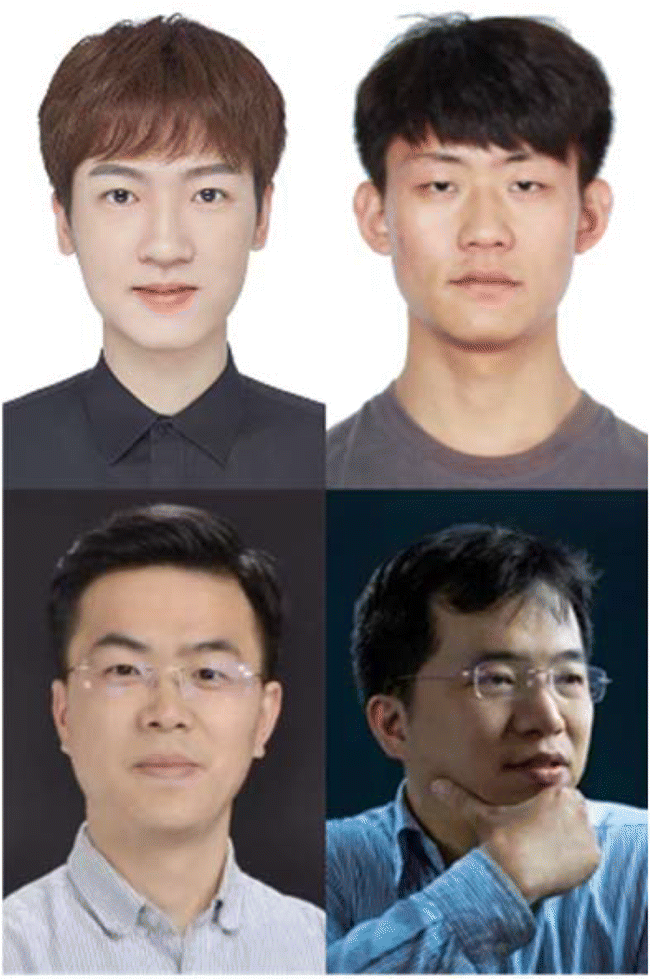
What do you see as the most significant insights or conclusions from your review?
In this contribution, we reviewed the state-of-the-art of fast-charging batteries for the electric vehicle market to clarify the technological gap between existing capabilities and extreme fast charging targets. From multiple dimensions such as energy density, charging speed, cycle life, and battery chemistry systems, we presented the latest academic progress and future research goals in fast-charging technology. Additionally, we analyzed the impact of electrode loading and battery configuration on fast-charging performance.
We emphasized the importance of focusing on fast charging for thick electrodes and called for the research community to establish a unified performance benchmarking system. When studying extreme fast charging, researchers should adopt Ah-level pouch cells with a single-sided areal capacity of no less than 3.0 mAh cm −2 and a charging rate of at least 4 C, while rigorously evaluating cycle life and lithium plating behavior in the cells.
What are the biggest challenges currently facing researchers in this area?
Battery fast-charging technology is a systemic challenge involving the complex interplay of multiple factors, such as electrode materials, electrolytes, electrode structures, and battery configurations. Researching from a single factor alone can easily lead to a fragmented understanding and self-deception. However, most researchers find it difficult to approach fast-charging development from a holistic and integrated perspective.
What do you hope readers take away from your review?
We hope readers can systematically consider and develop fast-charging technology from the perspectives of key cathode materials, electrolytes, electrode interfaces, and fast-charging safety. This will help avoid ineffective and unsustainable “performance improvements” resulting from non-systematic thinking during development.
We extend our sincerest congratulations to the authors of our 2025 Outstanding Papers whose work will continue to advance and shape battery science. We look forward to celebrating more exceptional work in the years to come.Emma Eley, Executive Editor Nour Tanbouza, Development Editor
Author Biographies
EES Batteries 2025 Outstanding Article
High-performance anode-less all-solid-state batteries enabled by multisite nucleation and an elastic network


EES Batteries 2025 Outstanding Review
Principles and trends in extreme fast charging lithium-ion batteries




References
- J. Oh, Y. Sohn and J. W. Choi, High-performance anode-less all-solid-state batteries enabled by multisite nucleation and an elastic network, EES Batteries, 2025, 1, 566–575 RSC.
- Y.-X. Yao, L. Xu, C. Yan and Q. Zhang, Principles and trends in extreme fast charging lithium-ion batteries, EES Batteries, 2025, 1, 9–22 RSC.
| This journal is © The Royal Society of Chemistry 2026 |