


Synthesis, structures and Cr2O72− fluorescence sensing properties of novel Zn(ii)/Cd(ii) metal–organic frameworks with diverse N/O-donor ligands
 *a
*a
Abstract
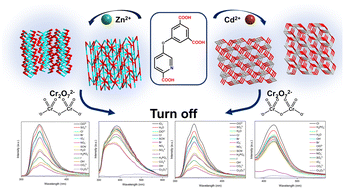
Four novel Zn(II)/Cd(II) metal–organic frameworks (MOFs 1–4), namely [Zn1.5(L)(bibp)(H2O)]n (1), [Zn1.5(L)(bimmb)(H2O)]n (2), {[Cd1.5(L)(bibp)0.5(H2O)]·2H2O·C4H8O2}n (3) and {[Cd1.5(L)(bimb)]·2.5H2O}n (4) (flexible H3L = 3-(3,5-dicarboxyphenoxy)-6-carboxypyridine, rigid bibp = 4,4′-bis(imidazolyl)biphenyl, semi-flexible bimmb = 1,4-bis(imidazol-1-yl methyl)benzene and flexible bimb = 1,4-bis(imidazol)butane), were synthesized under solvothermal conditions by using a reasonable design method and further characterized by single-crystal X-ray diffraction (SC-XRD), FT-IR spectroscopy, thermogravimetric analysis (TGA) and powder X-ray diffraction (P-XRD). Structural diversity was achieved by employing the three distinct N-donor ligands described above, and the resulting MOFs exhibited unique architectural topologies as follows: 1 and 2 exhibit entangled 1D chain structures that collectively form a 3D framework, while 3 and 4 possess a 3D network in an interspersed manner. Luminescence studies revealed that these MOFs exhibited high sensitivity and selectivity in fluorescence sensing applications, particularly for Cr2O72− anions with detection limits of 3.64, 2.08, 2.75 and 4.36 μM, respectively. Furthermore, the sensing mechanism for Cr2O72− by MOFs 1–4 is attributed to a competitive absorption process.
 Please wait while we load your content...


