Qing
Yu
a,
Takafumi
Yatabe
*ab,
Takehiro
Matsuyama
a and
Kazuya
Yamaguchi
*a
aDepartment of Applied Chemistry, School of Engineering, The University of Tokyo, 7-3-1 Hongo, Bunkyo-ku, Tokyo 113-8656, Japan. E-mail: kyama@appchem.t.u-tokyo.ac.jp; yatabe@appchem.t.u-tokyo.ac.jp; Fax: +81-3-5841-7220
bPrecursory Research for Embryonic Science and Technology (PRESTO), Japan Science and Technology Agency (JST), 4-1-8 Honcho, Kawaguchi, Saitama 332-0012, Japan
First published on 29th October 2025
Here, acceptorless dehydrogenative aromatization of cyclohexyl rings via benzylic C–H bond activation has been achieved using a supported Pd nanoparticle catalyst. In particular, Pd(0) nanoparticles formed in situ from Pd hydroxide species during the dehydrogenation reactions showed high catalytic performance and a wide substrate scope.
As the first step of acceptorless dehydrogenative aromatization, C–H bonds are conventionally cleaved according to hydrogen atom transfer (HAT) or deprotonation (Fig. 1(b)). With the assistance of photoredox catalysts, acceptorless dehydrogenative aromatization proceeds by HAT, which preferentially occurs at C–H bonds with low bond dissociation energies (BDEs).2 As for C–H bonds which exhibit high acidity, such as α-positions of ketones and imines, C–H bond cleavage usually proceeds by deprotonation in dehydrogenative aromatization.3,4 Actually, our group has reported several examples of acceptorless dehydrogenative aromatization involving deprotonation using heterogeneous Pd or Ni nanoparticle catalysts.4 For broadening the scope of acceptorless dehydrogenative aromatization more, it is necessary to develop a new catalytic system applicable to C–H bonds in substrates which cannot tolerate radical reaction systems or which do not exhibit enough acidity for deprotonation. Thus, transition-metal-catalyzed C–H bond activation is considered as one of the ideal approaches for the initial C–H bond cleavage in acceptorless dehydrogenative aromatization.
Recently, our group has developed regioselective benzylic C(sp3)–H bond dehydrogenative silylation or borylation by utilizing a Ni(0) nanoparticle catalyst supported on CeO2 prepared via reduction with pinacolborane (Ni/CeO2–HBpin).5 In these reactions, benzylic C(sp3)–H bonds are supposed to be cleaved by selective non-radical C(sp3)–H bond activation on Ni(0) nanoparticles. In addition, as mentioned above, our group has also reported metal-nanoparticle-catalyzed acceptorless dehydrogenative aromatization reactions involving deprotonation followed by β-hydride elimination/disproportionation/H2 evolution.4 Based on these insights, we proposed acceptorless dehydrogenative aromatization of arylcyclohexane moieties by utilizing the catalysis unique to metal nanoparticle catalysts as the reaction starting from transition-metal-catalyzed C–H bond activation.
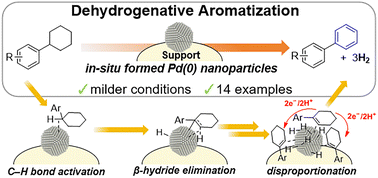
After various investigations, we have successfully developed acceptorless dehydrogenative aromatization of arylcyclohexane moieties by a supported Pd nanoparticle catalyst via benzylic C–H bond activation (Fig. 1(c)). In particular, in situ formed Pd(0) nanoparticles from supported Pd hydroxide species during the dehydrogenation reaction showed high catalytic performance to efficiently produce biaryls. This catalytic system demonstrated a wide substrate scope with good functional group tolerance in high yields under relatively mild conditions compared with previous reports on acceptorless dehydrogenative aromatization of arylcyclohexane moieties (Table S1).6
Acceptorless dehydrogenative aromatization of phenylcyclohexane (1a) to biphenyl (2a) was conducted in N,N-dimethylacetamide (DMA) at 170 °C under an Ar atmosphere using various supported metal catalysts which were prepared via deposition–precipitation followed by reduction (represented as metal/support-reductant) (see the SI for the detailed preparation methods). Initially, Ni/CeO2–HBpin, which was utilized in the regioselective benzylic C(sp3)–H bond dehydrogenative borylation/silylation,4 was tested; however, after the reaction for 15 min, 2a was yielded in only 4% (Table 1, entry 1). On the other hand, Pd/CeO2–HBpin afforded 2a in 42% yield (Table 1, entry 2). While other supported precious metal catalysts including Pt, Ru, Rh, and Ir were tested as well, Pd was the best metal species (Table 1, entries 3–7). To optimize the Pd catalyst, the reductants for Pd catalyst preparation such as HBpin, H2, sodium borohydride (NaBH4), and sodium naphthalenide (NaNaph) were investigated (Table 1, entries 2, 3, 8, and 9). As a result, among them, HBpin was the most suitable reductant for enhancing the 2a yield; however, surprisingly, the un-pretreated Pd hydroxide catalyst supported on CeO2 (Pd(OH)x/CeO2, Pd: 2.6 wt% determined by inductively coupled plasma atomic emission spectroscopy (ICP-AES), mean diameter of Pd: 2.1 nm (σ = 0.5 nm) determined by transmission electron microscopy (TEM) (Fig. S1)) gave a higher 2a yield (Table 1, entry 10). Other factors including solvent effects (Table S2), support effects (Table S3),† metal loading effects (Table S4), and temperature effects (Table S5) were investigated, and 2a was quantitatively obtained under the optimized reaction conditions (Table 1, entry 11). The amount of H2 formed in the dehydrogenative aromatization of 1a was confirmed to be 0.43 mmol after 4 h reaction using Pd/CeO2-HBpin in the closed system by gas chromatography (GC), which is approximately three times the amount of 2a (0.16 mmol), indicating that the present dehydrogenative aromatization proceeds without any hydrogen acceptors. Dehydrogenative aromatization of 1a using Pd(OH)x/CeO2 immediately stopped when the catalyst was removed by hot filtration, and Pd species were hardly detected in the filtrate after the reaction for 2 h by ICP-AES (0.086% of the Pd catalyst used for the reaction) (Fig. S2), indicating that the reaction was heterogeneously catalyzed. After the reaction of 1a for 1 h, TEM observation of the used catalyst revealed that the Pd nanoparticle sizes were almost unchanged (mean diameter: 1.9 nm) (σ = 0.6 nm) (Fig. S3), suggesting the high durability of the catalyst.
| Entry | Catalyst | Yield of 2a (%) |
|---|---|---|
| a Conditions: 1a (0.2 mmol), catalyst (supported metal: 3.6 mol%), DMA (2 mL), Ar (1 atm), 170 °C, and 15 min. Yields were determined by GC. b 4 h. | ||
| 1 | Ni/CeO2–HBpin | 4 |
| 2 | Pd/CeO2–HBpin | 42 |
| 3 | Pd/CeO2–H2 | 34 |
| 4 | Pt/CeO2–H2 | <1 |
| 5 | Ru/CeO2–H2 | <1 |
| 6 | Rh/CeO2–H2 | 5 |
| 7 | Ir/CeO2–H2 | <1 |
| 8 | Pd/CeO2–NaBH4 | 8 |
| 9 | Pd/CeO2–NaNaph | 2 |
| 10 | Pd(OH)x/CeO2 | 46 |
| 11b | Pd(OH)x/CeO2 | >99 |
It is noted that the color of Pd(OH)x/CeO2 changed from yellow to black quickly within 2 min after the dehydrogenative aromatization of 1a started (Fig. S4). A similar color change was also observed when Pd(OH)x/CeO2 was pretreated by reductants. To investigate the change of the catalyst during the reaction, the catalyst was collected by filtration under an Ar atmosphere after the dehydrogenative aromatization of 1a for 15 min (Pd(OH)x/CeO2-used-15 min). Then, the diffuse reflectance infrared Fourier transform spectroscopy (DRIFTS) analysis of Pd(OH)x/CeO2-used-15 min was performed after exposure to a CO atmosphere (∼15 Torr), indicating large peaks originating from the linear (2000–2200 cm−1) and bridged (1900–2000 cm−1) CO species on the Pd(0) nanoparticles (Fig. S5).7 These results indicated that in situ formed Pd(0) nanoparticles were highly dispersed on the CeO2 support. Although IR absorption peaks originating from CO on Pd(0) species were observed in CO-DRIFT spectra of Pd/CeO2–NaBH4 and Pd/CeO2–NaNaph, the low intensity indicated that the exposed active sites are insufficient, which is the possible reason for the low catalyst activity and may be caused by the coverage of substances derived from the reductants (Fig. S6). Moreover, CO species on Pd(0) hollow sites were observed (1800–1900 cm−1) in the spectra of Pd/CeO2–H2 and Pd/CeO2–HBpin (Fig. S6),7 indicating the larger size of Pd nanoparticles in these catalysts prepared by the treatment of H2 or HBpin, which might lead to the lower activity in dehydrogenative aromatization of 1a.
Next, the substrate scope of acceptorless dehydrogenative aromatization using Pd(OH)x/CeO2 was investigated (Scheme 1). When p-methyl- or p-ethyl-substituted phenylcyclohexane was used as the substrate, the corresponding aromatized products (2b, 2c) were obtained. Dehydrogenative aromatization of the substrates with methoxy, hydroxy, or amino groups proceeded in good yields (2d–2i). The moderate yield in the case of o-methoxy substitution was possibly due to the steric hindrance (2f). Additionally, substrates with other substituents such as ester, amide, and acetyl groups were applicable (2j–2l). The dehydrogenative aromatization of multiple cyclohexyl rings in 1,4-dicyclohexylbenzene also successfully proceeded to form p-terphenyl (2m). Moreover, a multi-substituted cyclohexane with a phenyl group can be applied (2n). In addition to arylcyclohexane moieties, dehydrogenative aromatization of cyclohexyl phenyl ketone proceeded to give benzophenone (2o). Unfortunately, an alkyl-substituted cyclohexane and a heterocyclic-substituted cyclohexane could not be applied to this reaction (Fig. S7).
![]() | ||
Scheme 1 Substrate scope. Conditions: substrate 1 (0.2 mmol), Pd(OH)x/CeO2 (Pd: 3.6 mol%), DMA (2 mL), 170 °C, Ar (1 atm), 24 h. Yields are determined by GC. a Isolated yield. | ||
The mechanism of this dehydrogenative aromatization reaction was studied with several controlled experiments. In the dehydrogenative aromatization of 1a, the time course plots of 2a yields were not affected by a radical scavenger (2,6-di-tert-butyl-p-cresol (BHT)) (Fig. 2(a)). Thus, a radical mechanism is likely irrelevant in this dehydrogenative aromatization reaction. Furthermore, while the Pd/CeO2–HBpin-catalyzed dehydrogenative aromatization of cyclohexanone, which possesses acidic α-C–H bonds (pKa in dimethyl sulfoxide (DMSO) = 26.4),8 was largely promoted by the addition of Na2CO3 as the base, the production of 2a from 1a using Pd/CeO2–HBpin was not facilitated by Na2CO3 despite much lower acidity of benzylic C–H of 1a (pKa of toluene in DMSO = ∼42)9 (Fig. 2(b)), indicating that deprotonation is probably not involved in the present benzylic C–H bond cleavage. Conclusively, the C–H bond is supposed to be cleaved by the Pd nanoparticle catalyst via C–H bond activation like oxidative addition in this dehydrogenative aromatization.
Next, heptylbenzene-d2 (1p) was reacted with Pd/CeO2–HBpin in DMA at 170 °C under an Ar atmosphere for 4 h (Fig. 2(c) and Fig. S8). After the reaction, the deuterated ratio of the benzylic position dropped to 13%, while other C(sp3)–H bonds were considerably deuterated according to 1H NMR and 2H NMR. The deuteration of other unactivated C(sp3)–H bonds was probably caused by chain-walking, which is composed of β-hydride elimination followed by the reverse insertion of Pd–H species to alkenes.5b,10 Therefore, β-hydride elimination is supposed to be included in the dehydrogenative aromatization of arylcyclohexanes subsequent to the C–H bond activation. When the reaction time was shortened to only 1 min, the dehydrogenative aromatization of 1a catalyzed by Pd/CeO2–HBpin hardly formed 2a. Meanwhile, 1-phenylcyclohexene (1q) was immediately fully converted to 1a and 2a within 1 min in the approximate ratio of 2
:
1 using Pd/CeO2–HBpin (Fig. 2(d)). In addition, cyclohexene or cyclohexadiene motifs were not observed at all during the present Pd-catalyzed dehydrogenative aromatization from arylcyclohexanes. Based on these results and our previous reports,4 aromatization is supposed to occur according to fast disproportionation of the unsaturated alkene intermediates after β-hydride elimination possibly via a sequence of rapid two-electron/two-proton transfer between intermediate molecules on Pd nanoparticles.
Based on the aforementioned results and discussion, the proposed catalytic cycle for dehydrogenative aromatization of arylcyclohexanes catalyzed by in situ formed Pd(0) nanoparticles is shown in Fig. S9. In the beginning, an arylcyclohexane molecule is adsorbed onto the Pd nanoparticle followed by (i) the activation of the benzylic C(sp3)–H bond possibly via oxidative addition. Then, (ii) β-hydride elimination occurs to form the unsaturated alkene intermediate along with Pd–H species. After repeating the steps of (i) and (ii) for another two arylcyclohexane molecules, (iii) disproportionation of the unsaturated intermediates proceeds rapidly via two-electron/two-proton transfer within intermediate molecules on the Pd nanoparticle catalyst, providing the stable biphenyl product. Finally, (iv) H2 molecules are formed from hydrides on the Pd catalyst, and the catalyst is restored.
In addition, kinetic investigations were carried out to determine the turnover-limiting step. As mentioned above, the disproportionation should be extremely rapid, which indicates that benzylic C–H activation or β-hydride elimination is the turnover-limiting step. When phenylcyclohexane-1-d1 (1r) was used in the presence of Pd/CeO2–HBpin, the initial production rate of 2a was similar to that from undeuterated 1a (kH/kd1 = 0.98), indicating that benzylic C(sp3)–H bond activation is less likely to be the turnover-limiting step (Fig. S10). In contrast, the initial production rate starting from 1a was faster than that from phenylcyclohexane-d10 (1s) (kH/kd10 = 1.73) (Fig. S10). Therefore, β-hydride elimination is supposed to be the turnover-limiting step of this dehydrogenative aromatization.
In summary, acceptorless dehydrogenative aromatization of various arylcyclohexanes via benzylic C(sp3)–H bond activation using a supported Pd nanoparticle as the heterogeneous catalyst has been successfully developed. This study provided a new catalytic dehydrogenation system, which is promising to extend the platform of organic synthesis and can hopefully be applied to the field of liquid organic hydrogen carriers.
This work was financially supported by JSPS KAKENHI grant no. 22H04971, 24K17556, 24H01062 (Transformative Research Areas (A) JP21A204), and 24H02210 (Transformative Research Areas (A) JP24A202). This work was supported by JST, PRESTO Grant Number JPMJPR227A, Japan. A part of this work was conducted at the Advanced Characterization Nanotechnology Platform of the University of Tokyo, supported by “Nanotechnology Platform” of the Ministry of Education, Culture, Sports, Science and Technology (MEXT), Japan. Q. Y. was supported by JST SPRING, Grant Number JPMJSP2108. We thank Dr Hui Li for his help with preliminary experiments.
Footnote |
| † After the reactions using various Pd-supported catalysts, only in the case of the CeO2 support was the filtrate colorless, while brownish colors were observed using the other supports, suggesting the leaching of Pd species (Fig. S11). |
| This journal is © The Royal Society of Chemistry 2025 |