The effect of tunable graphene oxide sheet size on the structures and catalytic properties of three-dimensional reduced graphene oxide sponge

Meisong Wang, Yanli Huang, Yuanyuan Wang* and Liyi Dai
College of Chemistry and Molecular Engineering, East China Normal University, 500 Dongchuan Road, Shanghai 200241, China. E-mail: ecnu_yywang@163.com; Fax: +86-21-54340133; Tel: +86-21-54340133

Received 29th September 2016 , Accepted 22nd November 2016

First published on 22nd November 2016


Abstract

Based on the selective precipitation of graphene oxide sheets (GOSs), large, medium and small GOSs would be narrowed and controlled by adjusting the time and speed of centrifugation. This size selection principle was used to investigate the influence of GOS size on dispersion, structure, and stacking behavior of GOSs. The structures and catalytic properties of three-dimensional reduced graphene oxide (3D rGO) sponge could also be controlled by the tunable GOS size. These differences due to the different GOS size were correlated to multiscale elemental and structural characteristics of GOSs, such as C/O ratio, the content of oxygen-containing groups on the GO edge, and Raman intensity ratio of D to G-bands of GO on the molecular scale. The relationship between GOS size and the structures and catalytic properties of 3D rGO sponge was established.

Introduction

By the look of graphene's development, it is of fundamental and practical significance to translate the novel physicochemical properties of individual graphene sheets into the macroscale by the assembly of graphene building blocks into macroscopic architectures with structural specialities and functional novelties.1 Graphene-based macroscopic materials such as one dimensional graphene (1DG) fiber, two dimensional graphene (2DG) paper and three-dimensional reduced graphene oxide (3D rGO) sponge have attracted significant attention as a means of further expanding the significance of graphene.

Graphene, reduced from graphene oxide (GO), can be well used as the building block for the preparation of graphene-based macroscopic materials. The lateral dimensions of graphene oxide sheets (GOSs) play an important role in determining the structures and properties of graphene-based macroscopic materials. Unfortunately, GOSs are usually inevitably cut into small pieces upon mechanical agitation, oxidation, sonication, and subsequent chemical reactions with water during the preparation process.2,3 These processes can result in a wide size distribution.

Generally, the structures and properties of macroscopic materials could be improved by narrowing the size distribution of GOSs. Both large and small graphene sheets reduced by GOSs with a narrow size distribution have their merits.4 Large graphene sheets are ideally suited for the preparation of highly-aligned graphene papers,5 ultrastrong graphene fibers6 and transparent conductive films.7 Small graphene sheets with a higher edge-to-area ratio are more hydrophilic and stable in solution. They possess more electrochemically active edging sites and better biocompatibility,8,9 and are widely applicated in biological and catalytic areas. In these cases, 1DG fiber and 2DG paper with uniform GOS size have been widely studied. 3D rGO sponge with tunable GOS size has been studied with size-dependent adsorption.10 However, the relationship between GOS size and the structures and catalytic properties of 3D rGO sponge has been rarely reported.

Recently, many efforts had been made to narrow the size distribution of GOSs to some extent. Chemical strategies such as polar solvent-selective natural deposition method11 and pH-assisted selective sedimentation12 were based on dispersibility and stability of GOSs in appropriate solvent. The main issue of these methods was the introduction of foreign components to GO dispersion resulting in the possibility of changing the chemical structures of GOS.4 Physical strategies such as density gradient ultracentrifugation13,14 and dialysis method15 were restricted by low yield and complicate procedure. Besides, filtration through track-etched membranes4 and liquid crystal size selection16 both were effective approaches for the size separation of GOSs. However, the resulting solution with the keenly low concentration was unsuitable to form 3D rGO sponge. Although the fractionated GO solution could be concentrated, it was still hard to obtain uniform GOSs and controllable concentration. Besides, the additional concentrated process made the operation more complicate. Therefore, there were still some unresolved issues on how to obtain 3D rGO sponge with uniform GOS size. Obviously, a more systematic study was necessary to establish the GOSs size–structure relationship for fundamental researches and practical applications of 3D rGO sponge macroscopic materials.5

Based on the selective precipitation of GOSs, three kinds of tunable GOSs with narrow size distributions were prepared in this paper. Uniform GOS size would be narrowed and controlled by adjusting the time and speed of centrifugation. This size selection principle was used to investigate accurately the influence of tunable GOS size on dispersion, structure, and stacking behavior of GOSs. The 3D rGO sponge prepared with large, medium and small GOSs also had differences both in structures and catalytic properties. We demonstrated that the GOS size had substantial influence on 3D rGO sponge, including the alignment of graphene sheets, pore structure, specific surface area, strength and catalytic activity.

Results and discussion

Effects of GOS size on dispersion and structure of GOSs

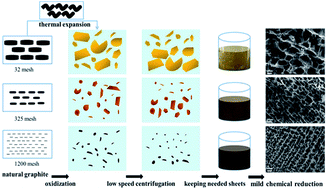
Fig. 1 illustrated the process of separation and preparation of the tunable GOSs. GOSs could form the stable colloidal dispersions. The ionization of the oxygen-containing groups resulted in the strong electrostatic repulsion among GOSs. The hydroxyl and epoxide groups were mainly on the basal planes, and ionizable carboxylic acid groups were mostly at the edges of GOSs.17 Those groups could overcome the van der Waals force from the carbon framework and made GOSs easier to disperse in water.18,19 Therefore, SGO solution with more oxygen-containing groups had higher solubility. The solubility of GOSs in water also decreased with the decreasing pH value of their dispersion, because the repulsion force between GOSs were weakened by the protonation of their carboxyl groups. Thus, the dispersion of GOSs was affected by GOS size in acid solution. Larger GOSs would be accelerated to sedimentate firstly within a short time via a low speed centrifugation, when the mixture was washed with hydrochloric acid aqueous solution (Fig. 1). After narrowing the size distribution, LGO in acid solution exhibited a color of luminous yellow. MGO and SGO showed khaki and dark brown, respectively. In acid solution, the large GOSs aggregate together, resulting in the dispersion of macroscopic lamellar structure in the solution. This lamellar structure can reflect more light. Therefore, the color of LGO solution shows a color of luminous yellow. When the smaller GOSs disperse in acid solution, diffuse reflection occured. Therefore, the color of SGO solution is darker than that of LGO solution (Fig. 1).
image file: c6ra24253g-f1.tif
Fig. 1 Schematic illustrations of the mechanism of ideal GOS size fractionation.

Based on different GOSs dispersion, three kinds of homogeneous and controllable size distribution of GOSs were prepared successfully. After dialysis and exfoliation, the SEM images of GOS size distribution, and corresponding size distribution histograms were shown in Fig. 2(a and b), respectively. After size fractionation, the GOSs were mostly smaller than 20 μm in SGO, 20–43 μm in MGO, and larger than 60 μm in LGO. The different GOS size distribution also reflected the structural differences among GOSs. Usually, the larger the GO sheet is, the higher the C/O ratio will be.14 Elemental analysis (Table 1) indicated that the C/O atomic ratios of SGO (1.10), MGO (1.13), and LGO (1.28) increased with growing GOS size. It suggested that the smaller GOS size distribution had more oxygenated groups within unit surface area.


image file: c6ra24253g-f2.tif
Fig. 2 Typical SEM images (a–c) and corresponding histograms of GOS size distribution (d–f) of SGO, MGO, and LGO.
Table 1 Elemental analysis of GO sponge with different sheet size
  C (wt%) H (wt%) O (wt%) C/O (atomic ratios)
SGO 43.85 2.74 53.12 1.10
MGO 44.27 2.91 52.37 1.13
LGO 47.56 2.48 49.57 1.28


Based on those structural differences of GOSs, the exfoliate extent of graphite oxide could be characterized by UV-vis spectroscopy after each freeze–thaw cycle. The resultant supernatant solution after centrifugation was diluted with distilled water by a factor of 100.20 The UV-vis spectra of the representative LGO and MGO from each freeze–thaw–centrifugation cycle are exhibited in Fig. 3(a and b). The crude SGO was exfoliated by ultrasonication as shown in Fig. 3c. The absorbance of peaks increased gradually with the freeze–thaw cycle (Fig. 3a and b). The peak at 231 nm and the shoulder at approximately 300 nm could be assigned to π → π* transitions of aromatic C–C bonds and n → π* transitions of C–O bonds, respectively.21 The results indicated an increased concentration of GOSs.22 It further demonstrated that LGO dispersion had the highest content of C–C bonds and the weakest peak of C–O bonds comparing with MGO and SGO (Fig. 3d).


image file: c6ra24253g-f3.tif
Fig. 3 UV-vis spectra characterizing the supernatant LGO (a), MGO (b) solutions collected before (black) and after each freeze–thaw–centrifugation cycle: red for one cycle, blue for two cycles, green for three cycles, purple for four cycles and SGO (c) before (black) and after ultrasonication (red). Each solution was diluted with distilled water by a factor of 100. The arrow indicated the progress of exfoliation of graphite oxide. UV-vis spectra (d) of LGO (black), MGO (red), and SGO (blue). 532 nm excited Raman spectra (e) and ID/IG intensity ratios (f) of SGO (blue), MGO (red), and LGO (black), respectively during preparation.

The structural differences of defects and functional groups of GOSs could be characterized by Raman spectra. The typical Raman spectra of graphene-based materials exhibited the D-, G-, and 2D-bands of carbon. The D-band located at 1330–1340 cm−1 was associated with the breathing modes of six membered carbon rings activated by defects. The G-band at 1580–1600 cm−1 was assigned to the E2g phonons at the Brillouin zone center.23,24 The three portions in graphene oxide were shown in Fig. 3e. The proportionality of ID/IG to the number of rings led to a new relation for stage 2: ID/IG = C′(λ)LD2. ID/IG, the intensity ratio of D to G-bands, could be used to evaluate the average distance between defects (LD) in graphene.25 The ID/IG s of SGO, MGO, and LGO were measured to be 0.876, 0.956 and 0.970, continuing to increase with increasing GOS area. Therefore, larger GOSs had fewer defects and less functional groups.26 The three steps of separation were shown in the abscissa (Fig. 3f): crude GO, separated GO, and exfoliated GO. The structural change of GOSs were exhibited in Fig. 3f, during the synthetic process of SGO, MGO and LGO. The ID/IG s of MGO and LGO increased with the size fractionation and exfoliation due to the increasing sheet size. SGO was exfoliated by ultrasonication. During this process, the GOSs were usually inevitably cut into small pieces. This physical process will produce more defects, resulting in the decrease of the average distance between defects (LD). So, the ID/IG ratio of SGO showed a decreasing trend.

Effects of GOS size on stacking behavior of GOSs

The stacking behavior of GOSs was affected by GOS size. SEM images (Fig. 4) showed that GOSs had different stacking behavior in GO sponge. GO sponge was formed by paralleled, slant and cross stacking of GOSs through both π–π stacking and hydrogen bonding, respectively. LGO and MGO sponge had interconnected 3D porous network as imaged by SEM (Fig. 4a). Unordered accumulation was shown in SGO sponge. The macrostructure of GO sponge was depended on the stacking of different size sheets, as shown in the inset (Fig. 5a). A cylinder was shown by LGO and MGO sponge and a obvious collapse of structure was exhibited by SGO sponge. Consequently, the macrostructure of resulting materials was strongly related to the GOS size.
image file: c6ra24253g-f4.tif
Fig. 4 SEM images of GO sponge (a–c) and 3D rGO sponge (d–f) of SGO, MGO and LGO.

image file: c6ra24253g-f5.tif
Fig. 5 XRD patterns of GO sponge (a) (inset shows the photographs of SGO sponge, MGO sponge, and LGO sponge), GO paper (b) and 3D rGO sponge (c). Raman spectra of 3D rGO sponge (d) (inset shows the photographs of rSGO, rMGO, and rLGO sponge) (SGO (blue), MGO (red) and LGO (black)).

The porous structure of 3D rGO sponge was also affected by GOS size. Freezing GO dispersions directly resulted in an oriented porous structure. Through controlling the amount of oxygen-containing groups (reduction time) and freezing conditions accurately, pore structure could be readily obtained by partially reduced GO. The pore walls were consisted of thin layers of stacked graphene sheets. The pore size in the network was affected by the GOS size. In Fig. 4b, 3D rGO sponge showed clearly and relatively ordered pore structure. The ordered and large-scale pore structure with a smaller size was shown in 3D rSGO sponge, while larger pore size was shown in 3D rLGO sponge. The pore size of rGO sponge increased with the increasing dimension of GOS. Besides, the clear and uniform pore structure may be also influence the volume of 3D rGO sponge. The 3D rLGO sponge constituted with larger GOSs had larger volume, as shown in the inset (Fig. 5d).

The 3D rGO sponge prepared with tunable GOS size had different specific surface areas (SSAs). It was measured by the standard method of methylene blue absorption.27,28 The SSAs increased with the growing GOS size. The SSAs of rSGO, rMGO, and rLGO sponge were 706, 842 and 975 m2 g−1, respectively. Large GOSs led to an incompact and fluffy three dimensional structure, due to the larger pore structure. This structure had a relatively poor mechanical property, but it was not conform with the conclusion of previous researches. 1DG fiber6 and 2DG paper5 constructed by large sheet had great strength. It was due to the lack in ordering degree of 3D rGO sponge. Ordered stacking and assembly of large GOSs could take its advantage inherited from graphene sheet and then obtain good mechanical property. Therefore, better mechanical properties were decided by ordered alignment of LGO sheets with larger area and lower defects. Only in this way, 3D rGO sponge with larger GOSs can had better potential for the broad application by improving the method of self-assembly of GOSs.4–6

The structures of GO sponge also depend on the GOS size, and the X-ray diffraction (XRD) patterns of SGO, MGO, and LGO sponge were shown in Fig. 5a. With the increasing of GOS area, the 2θ values of GO sponge presented a decreasing trend. Their d-spacings were calculated to be 7.48, 8.01 and 8.23 Å correspondingly. The reason for this phenomenon was that larger sheets had a lot of unordered stacking. Herein, a larger d-spacing was observed, conforming that GO sponge with larger GOSs had a lot of spaces. On the other hand, the d-spacing was connected with the number of oxygen-containing functional groups of GOS. For example, the 2θ values of GO paper presented a rising trend with increasing GOS area (Fig. 5b). The corresponding d-spacing between the adjacent GO sheets showed a decreasing trend, namely 8.05, 7.99, and 7.54 Å for SGO, MGO and LGO paper, respectively. The different results between sponge and paper indicated that d-spacing of GO sponge was mainly due to the unordered stacking of GOS, not the number of oxygen-containing functional groups.

The structure of 3D rGO sponge was characterized by XRD patterns and Raman spectra. The XRD patterns (Fig. 5c) of 3D rGO sponge prepared with SGO, MGO, and LGO exhibited single characteristic (002) reflection peak at similar positions (2θ = 24.62°, 24.54 and 24.47°). Besides, the d-spacing of the 3D rGO sponges clearly display upward tendency with increasing GOS size, from 3.57 Å for SGO to 3.63 Å for LGO, respectively. Further reductive 3D rGO sponge still had larger space between sheets, leading to a larger d-spacing. Raman spectra of 3D rGO sponge (Fig. 5d) showed stronger D-bands with respect to G-bands. It showed the partial restoration of graphitic structures.25 The ID/IGs of the 3D rGO sponge with different sizes were nearly identical to 1.45. It indicated that 3D rGO sponge constituted with different GOS size had a similar structure.

Effects of GOS size on catalytic performance of rGO based composite catalyst

The GOS size had an influence on 3D rGO-based composite catalyst. The Pt nanoparticles supported on rGO with different GOS size were prepared. The catalytic performance of Pt–rGO composite was studied by the reduction of 4-nitrophenol (4-NP) to 4-aminophenol (4-AP) with NaBH4. The reduction process could be easily monitored by UV-vis spectra because of the feature absorption at 400 nm and 300 nm for 4-NP and 4-AP, respectively. The peak at 400 nm vanished gradually with the addition of catalyst, and concomitantly the absorption peak at around 300 nm was emerged. Pt–rGO composite prepared with SGO solution had the best catalytic effect at 6 min, as shown in Fig. 6.
image file: c6ra24253g-f6.tif
Fig. 6 Successive UV-vis absorption spectra of the reduction of 4-NP by NaBH4 in the presence of 3D rGO based composite catalyst prepared by SGO (a), MGO (b) and LGO (c).

For exploring the reason of the difference in catalytic effects, the distribution of Pt nanoparticles on 3D rGO sponge was shown in Fig. 7. The smaller GOSs were, the more Pt nanoparticles deposited on the 3D rGO sponge with a smaller particle size. The ICP-AES result indicated that the Pt loading was about 8.76%, 8.38% and 8.08% in 3D rGO-based composite catalysts prepared by SGO, MGO, and LGO solution respectively. The result indicated that the composite catalyst prepared with SGO solution had the highest loading and the best catalytic activity. The optimal catalytic activity was due to a lot of oxygen-containing functional groups existing in SGO. The reducing of oxygen-containing functional groups from GO to rGO was attributed to the co-reduction process with removal of surface oxygen functionalities and deposition of Pt nanoparticles. During the simultaneous reduction reactions of Pt salts and GOSs, oxygen-containing functional groups on the GOSs can be consumed by providing anchoring sites for the Pt2+ ions and for the dispersion of Pt nanoparticles. However, some residual oxygen groups on the surface of 3D rGO sponge seemed to prevent serious aggregation of sheets in this work. Thus, the Pt nanoparticles could be well deposited on the 3D rGO ESI with SGO solution, and the catalytic effect was better than the larger one.29,30


image file: c6ra24253g-f7.tif
Fig. 7 TEM images of 3D rGO based composite catalyst prepared by SGO (a), MGO (b) and LGO (c).

Conclusion

In a word, we have developed a simple, efficient and scalable method to prepare tunable GOSs with narrow size distributions. The dispersion, structure and stacking behavior of GOSs strongly depend on their sizes. The 3D rGO sponge prepared with large, medium and small GOSs also have differences both in structures and catalytic properties. These differences are correlated to multiscale elemental and structural characteristics of GOSs, such as C/O ratio, the content of oxygen-containing groups on the GO edge, and Raman intensity ratio of D to G-bands of GO. The relationship between GOS size and the structures and catalytic properties of 3D rGO sponge was established. It is beneficial to further understand the property of graphene-based macroscopic materials and promote the development of graphene in practical applications.

Acknowledgements

This work was financially supported by the key project of Shanghai Science and Technology Committee (No. 14231200300), Shanghai Key Laboratory of Green Chemistry and Chemical Processes and SRF for ROCS, SEM.

Notes and references

  1. H. P. Cong, J. F. Chen and S. H. Yu, Graphene-based macroscopic assemblies and architectures: an emerging material system, Chem. Soc. Rev., 2014, 43, 7295 RSC .
  2. S. Y. Pan and I. A. Aksay, Factors Controlling the Size of Graphene Oxide Sheets Produced via the Graphite Oxide Route, ACS Nano, 2011, 5, 4073 CrossRef CAS PubMed .
  3. A. M. Dimiev, L. B. Alemany and J. M. Tour, Graphene oxide. Origin of acidity, its instability in water, and a new dynamic structural model, ACS Nano, 2013, 7, 576–588 CrossRef CAS PubMed .
  4. J. Chen, Y. R. Li, L. Huang, N. Jia, C. Li and G. Q. Shi, Size Fractionation of Graphene Oxide Sheets via Filtration through Track-Etched Membranes, Adv. Mater., 2015, 27(24), 1–7 CrossRef PubMed .
  5. X. Y. Lin, X. Shen, Q. B. Zheng, N. Yousefi, L. Ye, Y. W. Mai and J. K. Kim, Fabrication of highly-aligned, conductive, and strong graphene papers using ultralarge graphene oxide sheets, ACS Nano, 2012, 6, 10708 CrossRef CAS PubMed .
  6. Z. Xu, H. Y. Sun, X. L. Zhao and C. Gao, Ultrastrong Fibers Assembled from Giant Graphene Oxide Sheets, Adv. Mater., 2013, 25, 188–193 CrossRef CAS PubMed .
  7. Q. B. Zheng, W. H. Ip, X. Y. Lin, N. Yousefi, K. K. Yeung, Z. G. Li and J. K. Kim, Transparent Conductive Films Consisting of Ultralarge Graphene Sheets Produced by Langmuir Blodgett Assembly, ACS Nano, 2011, 5, 6039–6051 CrossRef CAS PubMed .
  8. X. M. Sun, Z. Liu, K. Welsher, J. T. Robinson, A. Goodwin, S. Zaric and H. J. Dai, Nano-Graphene Oxide for Cellular Imaging and Drug Delivery, Nano Res., 2008, 1, 203 CrossRef CAS PubMed .
  9. Z. Liu, J. T. Robinson, X. M. Sun and H. J. Dai, PEGylated Nanographene Oxide for Delivery of Water-Insoluble Cancer Drugs, J. Am. Chem. Soc., 2008, 130, 10876–10877 CrossRef CAS PubMed .
  10. S. Zhang, Y. Li, J. Sun, J. Wang, C. Qin and L. Dai, Size fractionation of graphene oxide sheets assisted by circular flow and their graphene aerogels with size-dependent adsorption, RSC Adv., 2016, 6, 74053–74060 RSC .
  11. W. J. Zhang, X. F. Zou, H. R. Li, J. J. Hou, J. F. Zhao, J. W. Lan, B. L. Feng and S. T. Liu, Size fractionation of graphene oxide sheets by the polar solvent-selective natural deposition method, RSC Adv., 2015, 5, 146 RSC .
  12. X. L. Wang, H. Bai and G. Q. Shi, Size Fractionation of Graphene Oxide Sheets by pH-Assisted Selective Sedimentation, J. Am. Chem. Soc., 2011, 133, 6338–6342 CrossRef CAS PubMed .
  13. X. Sun, Z. Liu, K. Welsher, J. T. Robinson, A. Goodwin, S. Zaric and H. Dai, Nano-Graphene Oxide for Cellular Imaging and Drug Delivery, Nano Res., 2007, 1, 203–212 CrossRef PubMed .
  14. X. Sun, D. Luo, J. Liu and D. G. Evans, Monodisperse chemically modified graphene obtained by density gradient ultracentrifugal rate separation, ACS Nano, 2010, 4, 3381–3389 CrossRef CAS PubMed .
  15. S. Kim, S. W. Hwang, M. K. Kim and D. Y. Shin, Anomalous Behaviors of Visible Luminescence from Graphene Quantum Dots: Interplay between Size and Shape, ACS Nano, 2012, 6, 8203–8238 CrossRef CAS PubMed .
  16. K. E. Lee, J. E. Kim, U. N. Maiti, J. Lim, J. O. Hwang, J. Shim, J. J. Oh, T. Yun and S. O. Kim, Liquid Crystal Size Selection of Large-Size Graphene Oxide for Size-Dependent N-Doping and Oxygen Reduction Catalysis, ACS Nano, 2014, 8, 9073–9080 CrossRef CAS PubMed .
  17. A. C. Ferrari, Raman spectroscopy of graphene and graphite: Disorder, electron–phonon coupling, doping and nonadiabatic effects, Solid State Commun., 2007, 143, 47–57 CrossRef CAS .
  18. A. M. Dimiev, L. B. Alemany and J. M. Tour, Graphene Oxide. Origin of Acidity, Its Instability in Water, and a New Dynamic Structural Model, ACS Nano, 2013, 7, 576–588 CrossRef CAS PubMed .
  19. W. S. Hummers and R. E. Offeman, Preparation of Graphite Oxide, J. Am. Chem. Soc., 1958, 80, 1339 CrossRef CAS .
  20. I. Ogino, Y. Yokoyama, S. Iwamura and S. R. Mukai, Exfoliation of Graphite Oxide in Water without Sonication: Bridging Length Scales from Nanosheets to Macroscopic Materials, Chem. Mater., 2014, 26, 3334–3339 CrossRef CAS .
  21. J. I. Paredes, S. Villar-Rodil, A. Martínez-Alonso and J. M. Tascón, Graphene oxide dispersions in organic solvents, Langmuir, 2008, 24, 10560–10564 CrossRef CAS PubMed .
  22. I. Ogino, Y. Yokoyama, S. Iwamura and S. R. Mukai, Exfoliation of Graphite Oxide in Water without Sonication: Bridging Length Scales from Nanosheets to Macroscopic Materials, Chem. Mater., 2014, 26, 3334–3339 CrossRef CAS .
  23. K. N. Kudin, B. Ozbas, H. C. Schniepp, R. K. Prud'homme, I. A. Aksay and R. Car, Raman spectra of graphite oxide and functionalized graphene sheets, Nano Lett., 2008, 8, 36–41 CrossRef CAS PubMed .
  24. A. C. Ferrari and J. Robertson, Interpretation of Raman spectra of disordered and amorphous carbon, Phys. Rev. B: Condens. Matter Mater. Phys., 2000, 61, 14095–14107 CrossRef CAS .
  25. M. M. J. Allister, J. Li, D. H. Adamson, H. C. Schniepp, A. A. Abdala, J. Liu, M. Herrera-Alonso, D. L. Milius, R. Car and R. K. Prud'homme, et al., Single sheet functionalized graphene by oxidation and thermal expansion of graphite, Chem. Mater., 2007, 19, 4396–4404 CrossRef .
  26. S. Eigler, C. Dotzer and A. Hirsch, Visualization of defect densities in reduced graphene oxide, Carbon, 2012, 50, 3666–3673 CrossRef CAS .
  27. S. H. Aboutaleb, M. M. Gudarzi, Q. B. Zheng and J. K. Kim, Spontaneous Formation of Liquid Crystals in Ultralarge Graphene Oxide Dispersions, Adv. Funct. Mater., 2011, 21, 2978–2988 CrossRef .
  28. P. Kundu, C. Nethravathi, P. A. Deshpande, M. Rajamathi, G. Madras and N. Ravishakar, Ultrafast Microwave-Assisted Route to Surfactant-Free Ultrafine Pt Nanoparticles on Graphene: Synergistic Co-reduction Mechanism and High Catalytic Activity, Chem. Mater., 2011, 23, 2772–2780 CrossRef CAS .
  29. P. Kundu, C. Nethravathi, P. A. Deshpande, M. Rajamathi, G. Madras and N. Ravishakar, Ultrafast Microwave-Assisted Route to Surfactant-Free Ultrafine Pt Nanoparticles on Graphene: Synergistic Co-reduction Mechanism and High Catalytic Activity, Chem. Mater., 2011, 23, 2772–2780 CrossRef CAS .
  30. Y. Noh, Y. Kim, S. H. Lee, E. J. Lim, J. G. Kim, S. M. Choi, M. H. Seof and W. B. Kim, Exploring the effects of the size of reduced graphene oxide nanosheets for Pt-catalyzed electrode reactions, Nanoscale, 2015, 7, 9438–9442 RSC .

Footnote

Electronic supplementary information (ESI) available. See DOI: 10.1039/c6ra24253g

This journal is © The Royal Society of Chemistry 2016
Click here to see how this site uses Cookies. View our privacy policy here.